Your company has a website. Someone posts on LinkedIn. SEO is happening somewhere.
An email goes out twice a month. Sales attends events. Maybe there are paid campaigns running too.
There is plenty of marketing activity. And yet someone eventually asks the uncomfortable question:
What exactly is the strategy? That is where many B2B companies discover that what looked like a marketing strategy was actually a collection of tactics. The channels were there.
The content was there. The campaigns were there. The strategic decisions connecting them were not.
A B2B marketing strategy should do something much more useful than generate an impressive slide deck or a crowded content calendar. It should tell the company:
- where to compete,
- which buyers matter most,
- why those buyers should choose it,
- how their decision is actually made,
- where marketing can influence that decision,
- where sales should enter,
- and how the company will know whether the entire system is working.
That distinction matters more than ever because modern B2B buyers are not patiently waiting for a sales representative to educate them. They are researching independently. Talking to peers.
Reading content. Comparing vendors. Using search engines.
Consulting AI. Building internal consensus. And often developing supplier preferences long before anyone raises a hand.
So the question is no longer:
“Which marketing tactics should we use?” A better question is:
“Which strategic decisions need to be true for those tactics to work?” That is what this guide is about.
What Is a B2B Marketing Strategy?
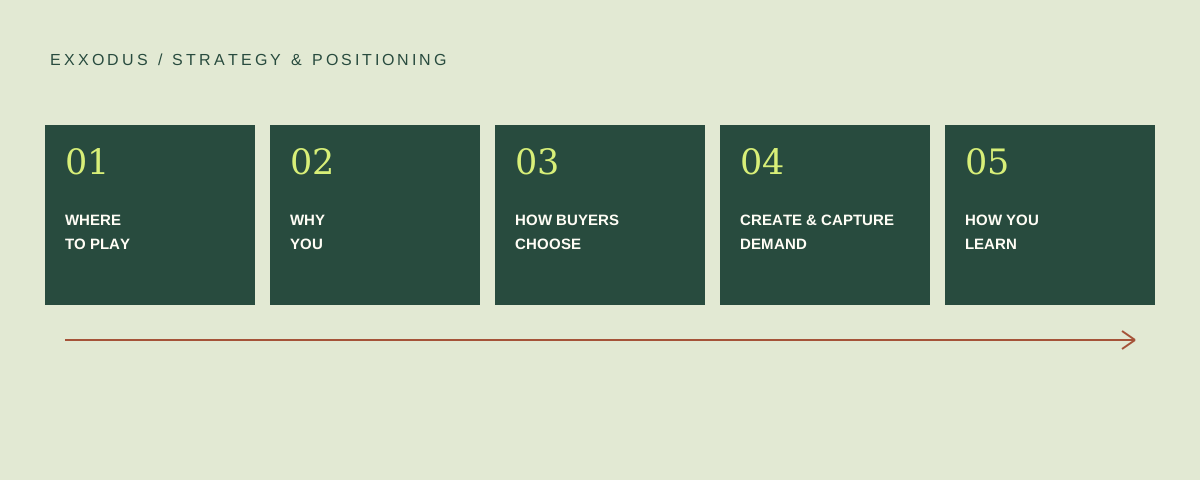
A B2B marketing strategy is the set of coordinated decisions a company makes about which business buyers to pursue, how to position itself, how it will influence buying decisions, how it will create and capture demand, and how marketing performance will connect to commercial outcomes. It answers five fundamental questions:
- Where will we play?
- Why should buyers choose us?
- How do those buyers actually choose?
- How will we create and capture demand?
- How will we learn and improve?
Everything else comes later. SEO is not the strategy. LinkedIn is not the strategy.
Email is not the strategy. ABM is not the strategy. Events are not the strategy.
Content is not the strategy. Those are mechanisms the strategy may use.
B2B Marketing Strategy vs. Marketing Plan vs. Marketing Tactics
These terms are frequently used as though they mean the same thing. They do not.
| Level | Question it answers | Example |
|---|---|---|
| Strategy | Where will we compete and how will we win? | Focus on mid-market industrial manufacturers expanding into the U.S. and differentiate around cross-market buyer communication |
| Plan | What will we execute to pursue that strategy? | Build an SEO/content program, outbound sequence, LinkedIn presence and sales materials over 12 months |
| Tactics | What specific actions will we take? | Publish an article, launch a PPC campaign, send an email sequence, attend an event |
| Metrics | How will we know whether it is working? | Qualified pipeline, target-account engagement, win rate, organic visibility, sales-cycle movement |
This distinction prevents one of the most common B2B marketing problems:
mistaking activity for direction.
Why B2B Marketing Strategy Is Different
B2B marketing has a structural challenge that most consumer marketing does not:
You are marketing to individuals who are buying on behalf of organizations. Those decisions can involve:
- financial risk
- operational risk
- career risk
- implementation complexity
- several departments
- long contracts
- multiple decision-makers
- internal politics
- procurement
- legal review
- technical validation
The person who discovers your company may not be the person who approves the purchase. The person who loves the product may not control the budget. And the person who can stop the deal may never fill out one of your forms.
That changes marketing fundamentally.
The B2B Buyer Is Not Starting From Zero
Traditional funnel thinking often assumes a buyer begins a purchase journey relatively neutral:
Need appears. Research begins. Vendors become visible.
Sales persuades the buyer. A winner emerges. Real B2B buying is messier.
6sense's 2025 Buyer Experience research examined nearly 4,000 recent B2B buying journeys. Its findings included:
- the average buying cycle was 10.1 months
- first seller contact occurred around 61% of the way through the journey
- roughly 80% of first seller interactions were initiated by buyers
- the winning vendor was already on the Day One shortlist 95% of the time
- buyers had usually ranked their shortlist before speaking with vendors
Source: 6sense, 2025 B2B Buyer Experience Report.
This creates one of the most important strategic implications in modern B2B marketing:
If buyers need to discover you only after they enter an active buying cycle, you may already be too late.
Marketing therefore has at least three jobs:
Before active demand
Create memory, familiarity, credibility and category relevance.
During research
Be discoverable and useful while buyers identify and compare solutions.
During validation
Help the buying group establish confidence, internal agreement and justification. That is much bigger than lead generation.
The Exxodus B2B Marketing Strategy Framework
We use five decisions to organize B2B marketing strategy:
1. WHERE TO PLAY
Which markets, customers and opportunities deserve focus?
2. WHY YOU
Why should those buyers consider and remember your company?
3. HOW BUYERS CHOOSE
Who influences the decision and what information do they need?
4. HOW YOU CREATE & CAPTURE DEMAND
How will buyers discover you before and during an active buying process?
5. HOW YOU LEARN
How will marketing, sales and customer information improve the strategy over time? These decisions should come before channel selection.
Decision 1: Where to Play
A strategy requires exclusion. If your target market is:
“companies that could benefit from our services” you do not yet have much of a target market. B2B companies often broaden their audience because they are afraid of leaving revenue behind.
The result is frequently the opposite. Messaging becomes generic. Content becomes generic.
Sales prospecting becomes inefficient. Media budgets spread thinly. Differentiation disappears.
A stronger strategy decides where the company has the best combination of:
- customer need
- product or service fit
- commercial value
- competitive advantage
- capability
- access
- growth potential
Start With Market Segmentation
Useful B2B segmentation can include:
Firmographics
- industry
- company size
- revenue
- geography
- ownership structure
Operational characteristics
- technology stack
- manufacturing process
- distribution model
- regulatory environment
- organizational maturity
- infrastructure
Situation
Often the most powerful segmentation variable. For example:
- entering a new market
- replacing a supplier
- scaling operations
- launching a product
- changing regulation
- merger or acquisition
- rapid hiring
- new leadership
- cost pressure
- technological change
Two companies with identical firmographics may have completely different buying intent because one is experiencing a trigger the other is not.
ICP Is Not the Same as Buyer Persona
Your ideal customer profile describes the type of organization most worth pursuing. A buyer persona describes people within that organization. For example:
ICP
U.S. manufacturer, 50–500 employees, exporting into Latin America, limited internal marketing resources, complex technical offering.
Potential buying-group members
- CEO
- VP Sales
- Marketing Director
- Export Manager
- technical subject-matter expert
Do not begin with fictional names and stock photographs. Begin with actual evidence from:
- existing customers
- sales calls
- lost deals
- CRM information
- search queries
- customer interviews
- support requests
- win/loss analysis
The question is not:
“Who could buy?” The question is:
“Who is strategically valuable enough to prioritize?”
Decision 2: Why You
Once you choose where to compete, you need a reason to matter there. That is positioning. Strong B2B positioning helps a buyer understand:
- what category you belong to
- who you are particularly relevant for
- what problem you solve
- what makes your approach meaningfully different
- why that difference matters
Weak positioning usually produces generic messaging. Consider phrases such as:
- innovative solutions
- trusted partner
- customer-focused
- end-to-end solutions
- world-class service
- cutting-edge technology
None is necessarily false. The problem is that competitors can usually say exactly the same thing.
Differentiation Needs Evidence
Instead of asking:
“What adjectives describe us?” ask:
“What can we credibly demonstrate that helps a buyer make a decision?” Evidence may include:
- specialization
- proprietary process
- technical capability
- methodology
- speed
- access
- expertise
- geographic coverage
- customer results
- integration
- risk reduction
- service model
- market knowledge
- documented proof
The objective is not to sound different. It is to be easier to distinguish.
Decision 3: Understand How Buyers Choose
This is where many B2B strategies become too simplistic. A persona is not a buying process. An MQL is not a buying group.
And the person who downloaded the white paper may not be the person whose concerns decide the deal. The 2025 Edelman–LinkedIn B2B Thought Leadership Impact Report focused specifically on what it calls hidden buyers: internal stakeholders who influence purchasing decisions even though marketing and sales may not see them directly. The research emphasizes that these stakeholders actively consume and evaluate thought leadership and can either support or obstruct a purchase.
Source: 2025 Edelman–LinkedIn B2B Thought Leadership Impact Report.
This means marketing needs to understand both:
the visible buyer and the internal conversation that happens after your visible buyer leaves your website or sales call.
Map Decision Requirements, Not Just Personas
For each significant buying role, determine:
What are they trying to accomplish?
What risk are they trying to avoid?
What evidence will they trust?
What objections are likely?
What information do they need from someone else?
What information do they need to share internally?
An operations leader may care about disruption. Finance may care about return and exposure. IT may care about integration and security.
Procurement may care about commercial terms and supplier risk. Leadership may care about strategic impact. One marketing message cannot do every job equally well.
Buyers Increasingly Want Self-Service, Until They Need Confidence
B2B marketing cannot be designed around the assumption that buyers want to speak with sales immediately. Gartner reported in May 2026 that, among 645 B2B buyers surveyed:
- 67% preferred a sales-rep-free buying experience
- 70% preferred a completely digital self-service experience
- buyers used an average of seven information sources
- 45% used generative AI during a recent purchase, primarily to research products and vendors
But another finding makes the picture more interesting:
69% preferred to validate AI-generated insights with a sales representative.
Source: Gartner, May 20, 2026, research on B2B buyers, AI and digital self-service.
This is not “digital versus sales.” It suggests a division of labor. Digital information helps buyers investigate independently.
Human expertise becomes particularly valuable when buyers need to:
- validate
- contextualize
- reduce risk
- resolve ambiguity
- build internal support
Your strategy should support both.
Decision 4: Create Demand and Capture Demand
This distinction is critical.
Demand creation
Makes the company mentally available before someone actively searches for a solution. It can include:
- thought leadership
- brand
- expert content
- video
- events
- PR
- social presence
- category education
- executive visibility
Demand capture
Helps the company appear when buyers are actively looking. It can include:
- SEO
- paid search
- comparison pages
- high-intent landing pages
- directories
- review platforms
- outbound against known intent
- conversion-focused website architecture
Healthy B2B marketing usually needs both. If you only capture demand, you compete for buyers after they have already formed preferences. If you only create demand, you may build recognition without a reliable mechanism for turning intent into opportunity.
Brand and Demand Generation Are Not Opponents
B2B marketing discussions sometimes treat brand and performance marketing as competing philosophies. That is a false choice. Brand influences:
- recognition
- recall
- trust
- perceived expertise
- willingness to investigate
Demand generation creates and develops interest. Demand capture makes the company visible when active intent appears. Sales helps buyers validate the decision and progress commercially.
These functions should reinforce each other.
Trust Is Becoming a Strategic Variable
LinkedIn's 2025 B2B Marketing Benchmark surveyed 1,500 senior B2B marketers across six countries. Among its findings:
- 42% ranked increasing brand awareness and reputation among decision-makers as their top business goal
- 78% said they used video in their marketing programs
Source: LinkedIn, 2025 B2B Marketing Benchmark.
The important insight is not that every B2B company suddenly needs a video department. It is that buyers need evidence of credibility from brands they are being asked to trust with consequential decisions. Trust can come from:
- customers
- subject-matter experts
- detailed expertise
- transparent explanation
- proof
- consistency
- case studies
- useful thought leadership
- peer validation
A strategy should determine which trust signals matter to its buyers.
Content Should Help Buyers Think
B2B content frequently falls into one of two traps.
Trap 1: SEO filler
Content exists because somebody found a keyword.
Trap 2: disguised advertising
Every article mysteriously arrives at:
“And that is why you should buy our product.” Useful B2B content can do something more valuable. It can help buyers:
- understand a problem
- frame a decision
- compare alternatives
- discover implications
- challenge an assumption
- build a business case
- explain something internally
That is where thought leadership becomes strategically useful. It gives the company a point of view the buyer can actually use.
SEO Still Matters, But Search Is Changing
Search has traditionally been one of the strongest B2B demand-capture mechanisms. Now the discovery environment is expanding. Buyers may research through:
- YouTube
- industry publications
- communities
- review sites
- ChatGPT
- Gemini
- Copilot
- Perplexity
- colleagues
- consultants
- analysts
That does not make SEO irrelevant. It makes information quality and discoverability across multiple interfaces more important. Good B2B content should be:
- specific
- authoritative
- clearly structured
- technically accurate
- supported with evidence
- easy to quote and understand
- genuinely useful
The future visibility question is larger than:
“Do we rank?” It is increasingly:
“Does the market's information ecosystem understand what we are credible about?”
How to Choose B2B Marketing Channels
Choose channels after strategy. Not before. A simple framework is to evaluate each possible channel against:
Buyer presence
Are the people or accounts actually there?
Buyer behavior
What are they doing there?
Strategic role
Does the channel create demand, capture it, validate decisions or nurture relationships?
Economics
Can the expected opportunity justify the investment?
Capability
Can your team execute the channel well enough to matter?
Common B2B Marketing Channels
SEO
Best suited to capturing research and existing demand where meaningful search behavior exists.
Paid Search
Useful for capturing high-intent searches faster than organic visibility may allow.
Useful for professional reach, expert visibility, thought leadership, account targeting and distribution.
Useful for nurturing known audiences and maintaining relevant communication over long cycles.
Events
Useful when relationships, demonstrations, education or high-value conversations matter.
Outbound
Useful when the target market is identifiable and the economics justify direct prospecting.
Partnerships
Useful when another organization already has access, trust or complementary capability with the audience.
Video
Useful for demonstration, expertise, human credibility and complex explanation.
PR and Industry Media
Useful for authority, third-party validation and category visibility.
Communities
Useful where buyers learn from one another and professional trust matters.
When Does Account-Based Marketing Make Sense?
ABM is valuable when the market is concentrated enough to justify account-level investment. It is especially relevant when:
- deal values are high
- the universe of possible customers is identifiable
- several stakeholders influence purchases
- sales cycles are long
- personalization can materially improve relevance
- sales and marketing can coordinate around the same accounts
ABM is not simply:
“we uploaded a company list to LinkedIn Ads.” The strategy comes from deciding which accounts matter and how coordinated activity can influence them. The software comes later.
Sales and Marketing Need the Same Model of the Buyer
“Sales and marketing alignment” has become such a common phrase that it can mean almost anything. A more useful goal is:
shared market intelligence. Sales continuously learns:
- which objections appear
- which competitors buyers mention
- why deals stall
- why companies buy
- why companies do not buy
- which claims resonate
- which proof buyers request
Marketing learns:
- what people search
- what content they consume
- which messages earn attention
- which pages convert
- which accounts engage
- which topics create demand
Those datasets should meet. Marketing should influence sales conversations. Sales conversations should influence marketing.
That is a learning system.
Decision 5: Build a Strategy That Learns
No B2B marketing strategy survives contact with the market completely unchanged. That is not failure. The purpose of measurement is not merely to prove that marketing worked.
It is to learn:
- which assumptions were correct
- which segments respond
- what buyers care about
- where opportunities stall
- which channels produce commercial value
- where messages fail
- where buyers need more evidence
B2B Marketing Metrics: What Should You Measure?
Measurement should operate at several levels.
Market visibility
- share of search
- brand search
- priority keyword visibility
- target-audience reach
- target-account awareness
Engagement
- meaningful content consumption
- returning visitors
- target-account engagement
- webinar participation
- relevant email engagement
Demand
- high-intent actions
- qualified inquiries
- meetings
- product/demo requests
- RFQs where applicable
Pipeline
- marketing-sourced pipeline
- marketing-influenced pipeline
- opportunity creation
- pipeline velocity
- stage progression
Economics
- customer acquisition cost
- cost per qualified opportunity
- average contract value
- win rate
- lifetime value
- marketing ROI
Strategic learning
- win/loss reasons
- content used by sales
- repeated objections
- competitor frequency
- stakeholder concerns
- emerging search demand
No single metric tells the entire story.
Why B2B Marketing ROI Is Difficult to Measure
B2B journeys are long and fragmented. A prospect might:
read an article, hear a podcast, see three LinkedIn posts,
Google the company, receive an email, talk to a colleague,
attend an event, return through direct traffic, and finally speak with sales.
Which interaction “caused” the purchase? That question often has no defensible single answer. LinkedIn reported in 2025 that 87% of surveyed B2B marketers struggle to measure the long-term impact of campaigns, while 66% face monthly scrutiny over marketing ROI.
Source: LinkedIn for Marketing, B2B marketing measurement research, May 2025.
This does not mean measurement should become vague. It means B2B companies need to combine attribution with broader evidence such as:
- account progression
- pipeline contribution
- brand demand
- qualitative buyer feedback
- win/loss information
- cohort performance
- sales intelligence
The goal is not perfect attribution. The goal is better decisions.
How to Create a B2B Marketing Strategy: Step by Step
Step 1: Define the Business Problem
Do not begin with:
“Marketing needs more leads.” Ask what the company actually needs to change. Examples:
- enter a new market
- increase category awareness
- reduce dependence on referrals
- improve pipeline quality
- reposition after a product change
- reach enterprise accounts
- launch a new product
- increase win rate
- generate demand in a new category
Step 2: Choose Where to Play
Define:
- priority market
- priority segments
- ideal customer profile
- exclusions
- relevant buying situations
Focus requires deciding who is not currently the priority.
Step 3: Research the Buyer and Buying Group
Use:
- customer interviews
- sales interviews
- CRM analysis
- win/loss reviews
- search research
- call transcripts
- buyer surveys
- customer-support intelligence
Understand both people and process.
Step 4: Analyze Competitors and Alternatives
Competitors are not only companies selling similar products. Alternatives may include:
- doing nothing
- maintaining the current supplier
- solving the problem internally
- choosing another category
- postponing the purchase
Understand what buyers believe they are comparing.
Step 5: Develop Positioning
Define:
- target buyer
- relevant problem
- category
- differentiated value
- supporting evidence
Then create a message architecture capable of adapting that positioning to different stakeholders and buying stages.
Step 6: Map the Buying Journey
Identify:
- triggers
- research questions
- stakeholders
- validation needs
- objections
- internal consensus requirements
- commercial steps
Do not assume a neat linear funnel. Use the map to identify where communication needs to exist.
Step 7: Decide How You Will Create Demand
Choose how the company will build awareness and familiarity before active buying. Possibilities include:
- thought leadership
- content
- executive visibility
- social
- video
- events
- industry media
- community
- partnerships
Step 8: Decide How You Will Capture Demand
Determine how buyers will find you when intent appears. Possibilities include:
- SEO
- paid search
- comparison content
- directories
- high-intent pages
- outbound
- review platforms
- partner referrals
Step 9: Build the Content and Sales Information System
Identify what buyers need to move forward. Examples:
- educational content
- product information
- case studies
- technical documents
- ROI material
- FAQs
- implementation information
- comparisons
- sales presentations
- executive summaries
Step 10: Choose Metrics Before Launching
Decide:
- what success means
- what leading indicators matter
- what commercial outcomes matter
- how often performance will be reviewed
- what would cause the strategy to change
That prevents metrics from being selected after the campaign based on whichever number looks best.
A Simple B2B Marketing Strategy Example
Imagine a technical services company wants to expand into mid-sized U.S. manufacturing firms. A weak strategy might say:
Goal: Generate leads. Channels: SEO, LinkedIn, email and PPC. That tells us very little.
A stronger strategic model looks like this:
Where to Play
Manufacturing companies with 100–500 employees undergoing expansion or process modernization.
Why You
Specialized technical expertise combined with faster implementation and direct access to senior specialists.
How Buyers Choose
Operations identifies the need, engineering validates capability, finance evaluates economics and leadership validates risk.
Create Demand
Technical thought leadership, expert LinkedIn content, industry partnerships and educational webinars.
Capture Demand
Industrial SEO, high-intent service pages, paid search and targeted outbound triggered by relevant company events.
Validation
Case studies, implementation documentation, ROI tools and access to technical experts.
Learning
Track target-account engagement, qualified opportunity creation, objections, win/loss patterns and pipeline by acquisition source. Now the channels have a reason to exist. That is strategy.
Common B2B Marketing Strategy Mistakes
1. Starting With Channels
“Should we be on TikTok?” Maybe. But that is approximately question number 27.
2. Defining the ICP Too Broadly
“Companies with 10–10,000 employees” is usually not focus.
3. Confusing Personas With Buying Committees
A decision-maker persona does not explain how multiple stakeholders reach agreement.
4. Treating Lead Generation as the Entire Job of Marketing
Marketing also shapes familiarity, preference, trust and internal validation before a lead exists.
5. Ignoring Brand Because It Is Harder to Attribute
Buyers cannot shortlist a company they do not know exists.
6. Producing Content Without a Point of View
Search visibility without useful thinking produces interchangeable content.
7. Sending Everyone to the Same CTA
Not every visitor is ready to book a demo.
8. Running ABM Without a Real Account Strategy
A list of company names does not make a program account-based.
9. Separating Sales Intelligence From Marketing
Every lost deal contains marketing information.
10. Measuring Whatever the Platform Makes Easy
Impressions are easy to count. That does not make them the objective.
11. Copying a Competitor's Channel Mix
You can see what competitors do. You usually cannot see why they do it, what it costs or whether it works.
12. Creating a Strategy That Never Changes
Strategy requires commitment. It also requires learning. Those are not opposites.
What Has Changed in B2B Marketing in 2026?
Three shifts deserve particular attention.
1. Buyers Have More Control
Independent research and self-service are normal parts of buying. Marketing information has to work even when no representative is present.
2. AI Has Become Another Research Interface
Buyers can gather, compare and summarize information without visiting every source individually. This increases the importance of accurate, structured and differentiated information.
3. Trust Has Become Harder to Earn
AI makes producing average content easier. That makes generic content less valuable, not more. Original expertise, evidence, recognizable people and useful perspectives become stronger differentiators.
B2B Marketing Strategy Is Ultimately About Making Better Choices
Marketing teams rarely suffer from a shortage of things they could do. They could:
launch a podcast, run ads, publish articles,
start a newsletter, attend events, build an ABM program,
post every day, buy another platform, redesign the website,
automate outbound, produce video, hire influencers,
experiment with AI. The difficult part is not finding another tactic. The difficult part is deciding which activities deserve resources, and why.
A strong B2B marketing strategy provides those decisions. It tells you:
Where to Play. Which customers and markets deserve attention. Why You.
What makes the company meaningfully relevant. How Buyers Choose. Who influences the decision and what they need to believe.
How You Create & Capture Demand. How the company becomes known before demand and discoverable when demand appears. How You Learn.
How marketing, sales and customer evidence improve the system. Once those decisions are clear, channels become much easier to choose. Content becomes easier to prioritize.
Sales receives better support. Measurement becomes more meaningful. And marketing stops looking like a pile of unrelated activity.
Because the goal of strategy is not to do more marketing. It is to make better marketing decisions.
Frequently Asked Questions About B2B Marketing Strategy
What is a B2B marketing strategy?
A B2B marketing strategy is a coordinated set of decisions about which business customers to pursue, how to position the company, how buying decisions happen, how demand will be created and captured, and how marketing will contribute to commercial objectives.
How do you create a B2B marketing strategy?
Start with the business problem, select the priority market and ICP, research the buying group, analyze competitors and alternatives, establish positioning, map the buying journey, choose demand-creation and demand-capture mechanisms, build the required content system and define commercial metrics.
What is the difference between a B2B marketing strategy and a B2B marketing plan?
The strategy explains where the company will compete and how marketing will help it win. The plan turns those strategic choices into specific campaigns, channels, budgets, owners and timelines.
What are the best B2B marketing strategies?
There is no universal best strategy. Effective approaches can include demand generation, content-led growth, account-based marketing, thought leadership, SEO, partner marketing and outbound. The appropriate combination depends on the market, deal economics, buyer behavior and business objective.
What are the most effective B2B marketing channels?
SEO, paid search, LinkedIn, email, events, outbound, partnerships, video and industry media can all be effective. Channel selection should follow buyer behavior and strategy instead of popularity.
What is account-based marketing?
Account-based marketing is a coordinated approach in which marketing and sales focus resources on a defined set of strategically valuable accounts and the buying groups within them.
Is content marketing still important in B2B?
Yes, but generic content is becoming less useful. Strong B2B content helps buyers understand decisions, evaluate alternatives, reduce risk and share useful insights internally.
How is AI changing B2B marketing?
AI is changing both marketing production and buyer research. Buyers increasingly use generative AI to investigate vendors and products, while marketers use AI across content, analysis and operations. This raises the importance of accurate information, differentiated expertise and human validation.
How should B2B companies measure marketing success?
Measurement should combine visibility, engagement, qualified demand, pipeline contribution, commercial economics and strategic learning. No single attribution metric can fully explain a long, multichannel B2B purchase.
How often should a B2B marketing strategy be reviewed?
The underlying strategic choices should remain stable long enough to generate meaningful evidence, while performance and assumptions should be reviewed regularly. Major market changes, buyer feedback, sales evidence or sustained underperformance may justify a strategic adjustment.
Does every B2B company need ABM?
No. ABM makes the most sense when account values are high, the addressable market can be clearly identified and coordinated account-level effort is economically justified.
What comes first: brand or lead generation?
Neither should automatically come first. B2B companies need to understand how buyers discover, remember and evaluate suppliers. Brand creates familiarity and preference; demand generation develops interest; demand capture converts existing intent. The appropriate balance depends on the company's market position.