What would convince an engineer that your company has solved a problem like theirs? A famous customer logo might earn a glance, but it cannot explain the material constraints, the decisions that mattered, or how the result was verified. That is the real job of manufacturing case studies: to turn completed work into evidence a prospective buyer can interrogate.
The best stories are not victory laps. They show the uncomfortable middle of a project, where trade-offs had to be made and the outcome was not guaranteed. This article explains how to select, interview, structure, and substantiate those stories without exposing confidential information or manufacturing a happy ending.
A case study is evidence, not a trophy
A buyer reading a case study wants to answer a specific question: have these people handled a situation meaningfully similar to mine? Similarity may involve material, tolerance, operating environment, regulatory requirements, delivery model, or the way a project was managed. The logo of a famous customer can attract attention, but a recognizable name does not explain what your team actually accomplished.
For example, a food-packaging buyer considering a new film structure may care about seal performance, line compatibility, print requirements, and approval steps. A story about how your company values innovation answers none of those questions. The evidence should show what was tested and under which conditions, not imply that every customer will receive the same outcome.
Choose projects that demonstrate a decision buyers face
Start with the sales conversations you wish were easier. Which applications cause buyers to hesitate? Which capability is consistently misunderstood?
Which objections require three calls to explain? Select projects that make those questions tangible, rather than automatically choosing the largest contract or the customer with the prettiest logo.
Build a shortlist with sales, engineering, quality, and account management. For each candidate, record the application, customer permission status, available documentation, measurable outcome, and commercial relevance. A technically fascinating project may still be the wrong story if its details are confidential or its application is outside your target market.
Interview for constraints before you interview for praise
A weak interview asks, “Were you satisfied?” A stronger one asks what the customer was trying to accomplish, what alternatives they considered, which requirements could not change, what nearly prevented progress, and how the team knew the solution was acceptable. Ask the project engineer separately what was difficult and what the final solution could not do.
Questions worth keeping include: What triggered the project? What were the operating conditions? Which specifications mattered?
Who had to approve the change? What did you measure before and after? What other changes occurred during the period?
Which information would you want a similar buyer to know before starting? A useful case-study interview is closer to reconstructing a decision than collecting compliments.
Use a structure that survives technical scrutiny
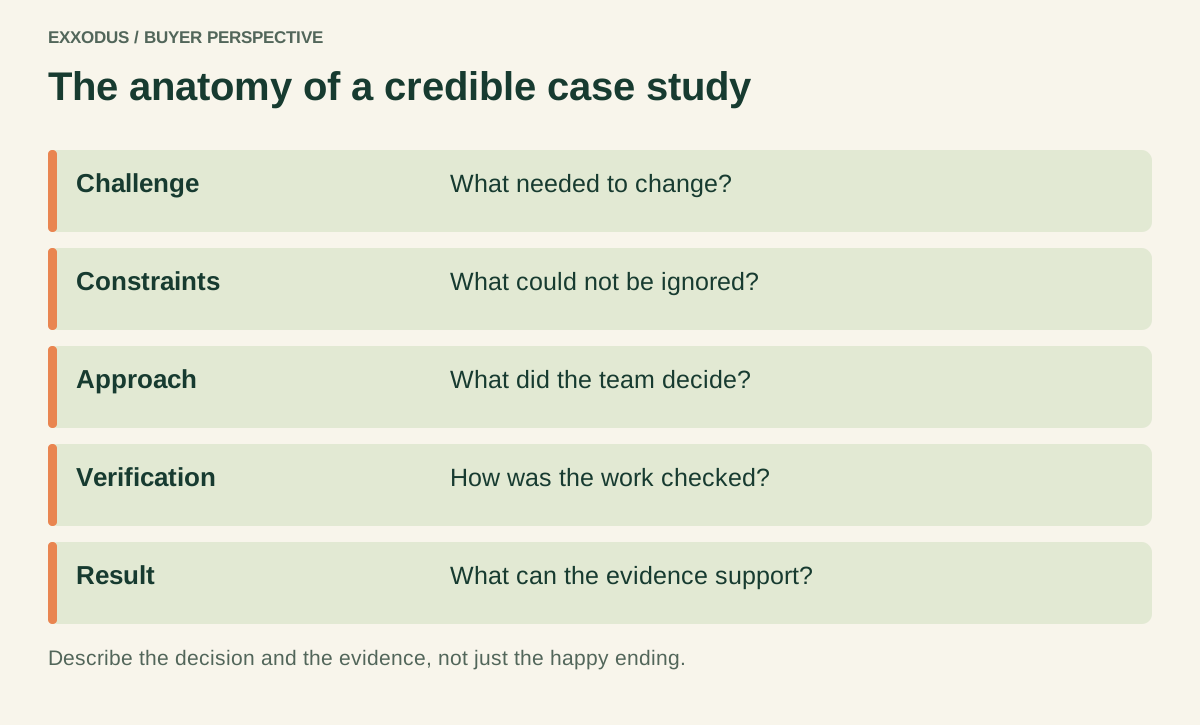
Organize the narrative around situation, constraints, approach, verification, outcome, and applicability. Situation explains why the project existed. Constraints tell readers what could not be ignored.
Approach identifies your contribution without claiming you invented every process involved. Verification describes the tests or acceptance criteria. Outcome states what happened, and applicability clarifies where the lesson is relevant.
A hypothetical custom-fabrication example might begin with an equipment maker needing sheet-metal enclosures that accommodated access and assembly constraints. The manufacturer reviewed drawings, identified bend and fastening questions, and collaborated on a revised design before production.
The evidence could include an approved drawing revision and documented inspection steps. Without actual time or cost records, do not add “30% faster” to make the story look impressive.
Make numbers explain something instead of decorating the page
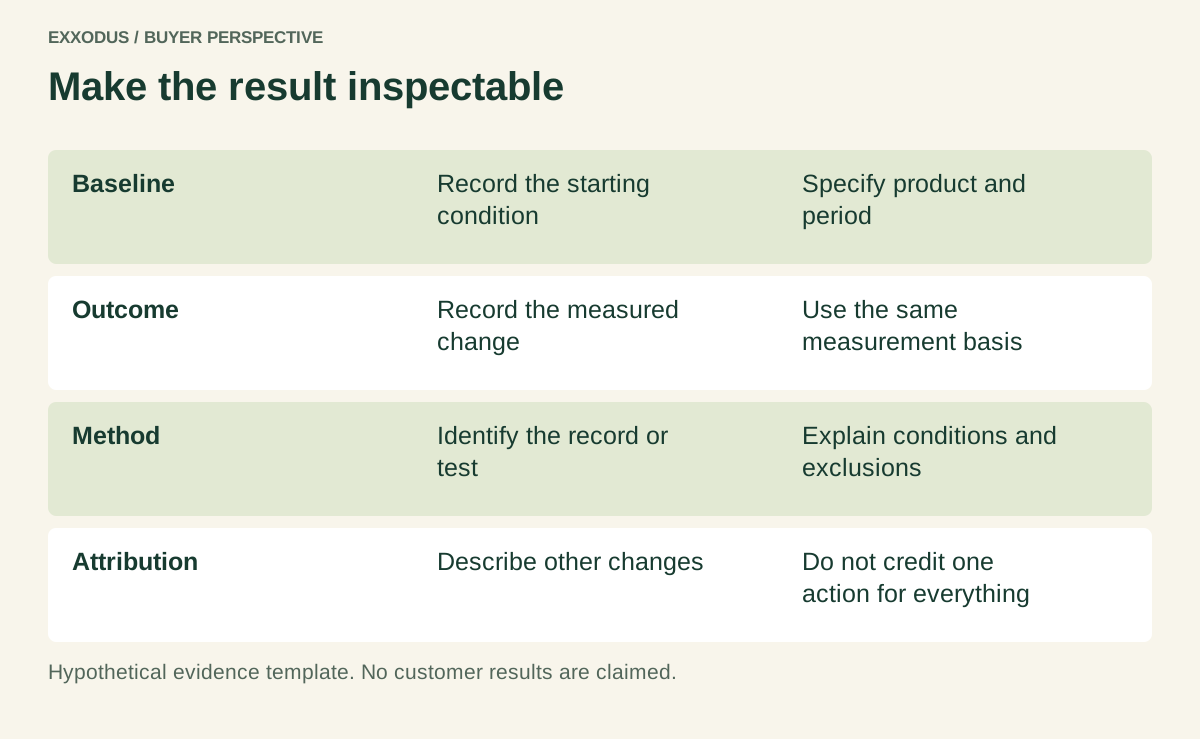
A percentage without a baseline is a decorative object. If scrap fell from 8% to 5%, explain the period, product, measurement method, and other changes that might have contributed.
That is a three-percentage-point reduction, not a five-percent reduction. If lead time changed, distinguish quoted lead time, production cycle time, and elapsed time from purchase order to delivery.
Use a measurement table with metric, baseline, outcome, period, data owner, and caveat. Have the responsible team verify it. If a customer cannot approve exact values, consider an accurately described range only with permission.
If neither is possible, describe a validated process improvement without a fabricated number. Credibility is more useful than numerical confetti.
Handle confidentiality like a grown-up
Many industrial projects involve drawings, formulations, supplier relationships, or production information that cannot be shared. Ask for approval before drafting.
Clarify whether you may identify the customer, sector, location, application, photographs, metrics, and quotes. Treat a verbal “sure” as the beginning of the approval process, not a license to publish everything in the shared drive.
An anonymized story can still be specific: “a regional food producer evaluating printed flexible packaging for a multi-SKU line” conveys useful context without naming the company. But anonymization is not simply removing a logo; a unique combination of equipment, location, and results may still identify the customer. Give the customer a review copy and retain a record of approval.
Show the work visually
A before-and-after photo is useful when it actually documents a change and the comparison is fair. A process diagram can clarify review, testing, and approval stages.
A simplified drawing can show an engineering trade-off without disclosing proprietary dimensions. An annotated chart can explain a verified trend far better than a stock image of sparks.
Every visual needs a job. Caption the measurement conditions, define acronyms, and indicate whether an illustration is conceptual.
Avoid staging an image that implies a customer installation or test that never happened. Industrial audiences can recognize a decorative factory photograph from three tabs away.
Adapt one story to different buying roles
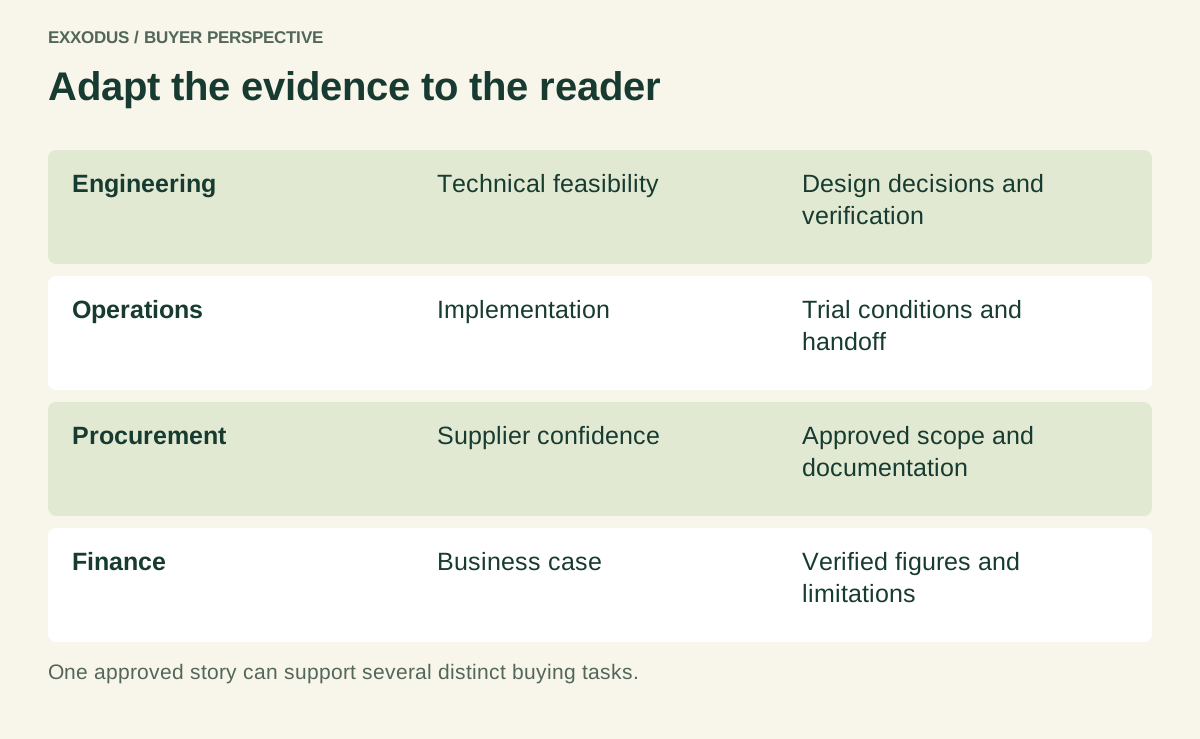
Engineering may want test conditions and integration constraints. Operations may ask what changed during implementation. Procurement may want supply continuity, qualification steps, and documentation.
Finance may care about the assumptions behind the economic case. Write one rigorous source story, then create role-specific summaries without changing the facts.
A one-page sales version can lead with the problem, constraints, and verified result. A technical appendix can hold drawings, methods, or specifications approved for sharing.
A short LinkedIn post can explain one decision or lesson, not simply link to the full story with “We are thrilled.” The goal is to help the buyer explain the decision internally.
A practical approval and publishing workflow
Assign an owner to fact gathering, technical review, customer approval, and publication. Record which version was approved and where the supporting data live.
Check the page on mobile, ensure tables are legible, and give readers a related capability or application page when they want context. A case study should be discoverable from the service it substantiates.
After publication, ask sales whether the story answers real objections. Track meaningful uses in opportunities, not just page views.
If the story keeps attracting inquiries for an application you cannot serve, revisit its framing. If prospects ask the same unanswered question, improve the story instead of producing another generic celebration.
A worked example: the packaging qualification story
Imagine a packaging producer supporting a regional food brand that is introducing several SKUs. The project begins not with a promise to transform the customer’s business but with a practical problem: the customer needs to compare packaging options while managing artwork approvals and line compatibility. A credible story identifies what was known at the start, which choices were open, and who owned each approval.
The supplier might document a material review, a trial plan, and a sequence for confirming artwork. If the customer approves publication, the story can explain how the process clarified decision-making.
It cannot claim reduced downtime or increased sales unless those results were measured and the supplier’s contribution can be stated accurately. This example is hypothetical; it is a writing model, not a reported Exxodus client outcome.
A case-study outline your team can reuse
Write a one-sentence description of the customer and application. Then describe the trigger for change, three nonnegotiable constraints, the options considered, the action taken, the evidence collected, and the result the customer approved for publication. End with the boundaries: where might this approach work, and what would require a new evaluation?
Keep an evidence register beside the draft. Each numerical claim should point to a record and an owner. Each quotation needs approval.
Each photograph needs permission. Each technical statement needs review by someone qualified to verify it. That may sound less glamorous than writing “game-changing partnership,” but it is how you build a story a procurement committee can actually use.
The mistakes that make a credible project sound unbelievable
Avoid making the customer a helpless character who was rescued by your heroic team. Buyers understand that industrial outcomes usually involve collaboration, iteration, and multiple contributors. Do not imply the chosen solution was the only possible option unless you can substantiate it.
Watch for selective baselines, undefined percentages, missing dates, and claims of universal applicability. Be particularly cautious with sustainability, safety, compliance, and financial savings: these require clear definitions and supporting evidence. A modest claim with an identifiable method beats a spectacular number with no explanation.
How to judge whether a story is ready
Before publishing, ask a colleague to read the draft without seeing the customer name. Can they identify the application, the reason the original situation was difficult, the role your company played, and the evidence that supports the conclusion? If not, the story probably relies too heavily on reputation.
Ask a technical reviewer to underline every statement that could be misunderstood as a performance guarantee. Ask sales whether a prospective buyer could use the document to answer a real objection.
A practical readiness check has five gates: documented project facts, verified technical statements, permission for identifying details, an honest outcome, and a clear lesson for the intended buyer. A story that fails one gate should be revised, not embellished.
If the only approved result is that a prototype passed a defined review, say exactly that. A buyer evaluating a supplier for a complex application may find that more useful than a broad promise of transformation.
Frequently asked questions
How long should a manufacturing case study be?
Long enough to explain the decision and substantiate the outcome. A concise web version with an optional technical appendix is often more useful than a long promotional narrative.
What if we cannot publish customer metrics?
Explain the verified process, acceptance criteria, and limits. Do not invent a percentage; a well-documented example can still establish competence.
Can we publish an anonymous case study?
Yes, with appropriate permissions and careful review of identifying details. Anonymous does not mean unverifiable or vague.
Give the buyer something useful to work with
Your next case study is probably sitting in a project folder, not waiting to be invented in a brainstorming meeting. Find a decision your buyers struggle to make, gather the records, and explain what your team did and what the evidence actually shows.
Exxodus helps manufacturers turn technical work into credible customer-facing stories. If your best projects are still invisible to prospects, that is a communication problem worth solving.
Sources and further reading
[1] NIST MEP, “Lean Transformation” (real published manufacturing success story; example of clearly identified challenge and results) ↗
[2] NIST MEP, “Improvement Activities” (industrial project context) ↗
[3] Google Search Central, “Creating helpful, reliable, people-first content” ↗