A manufacturer can tell you which alloy will tolerate the application, how a process changes the surface finish, and why a certain tolerance costs more. Ask what makes the company different, however, and the answer may suddenly become “quality, innovation, and exceptional customer service.” Apparently, the marketing department has misplaced the specifications.
None of those qualities is bad. The problem is that competitors claim them too. A manufacturing value proposition should give a particular buyer a concrete reason to consider your company for a particular job.
It connects the problem, your capability, the practical consequence, and the evidence. It does not need to be clever. It needs to be useful.
What a manufacturing value proposition actually promises
A value proposition is not a slogan, mission statement, or complete catalog of everything the company can manufacture. It is a concise explanation of whom you serve, which problem or requirement you address, how your approach fits, and why a buyer should believe you. NIST's Manufacturing Extension Partnership has similarly argued that smaller manufacturers can compete by defining the specific value they bring rather than relying on flashy promotion 1.
The phrase “we deliver quality products” describes a minimum expectation. A food producer ordering flexible packaging expects usable packaging.
A machine builder buying precision parts expects parts that meet the agreed specifications. Neither buyer has learned why your particular facility belongs on the shortlist.
An industrial value proposition becomes useful when it reflects a buying decision. Perhaps you are suited to short production runs with frequent artwork changes. Perhaps your engineering team supports early design-for-manufacturability discussions.
Perhaps your service coverage fits customers operating several shifts. These are possibilities, not claims to borrow. Confirm that the company can actually deliver them before putting them in the headline.
Start with the job, not the adjective
The easiest way to produce an interchangeable statement is to begin with a list of adjectives. Instead, examine recent opportunities. Which customers were a good fit?
What triggered the search? Which specifications, constraints, deadlines, approvals, or failure risks shaped the decision? Ask sales about won and lost opportunities, then ask engineering and operations whether the sales explanation matches reality.
Imagine a packaging manufacturer serving regional food brands. The buyer is not simply purchasing pouches. The buyer may be managing several SKUs, coordinating artwork approvals, and trying to avoid an unsuitable production minimum.
Those details change the message. “Custom packaging solutions” names the category. “Printed flexible packaging for regional food brands managing multiple SKUs, with a documented artwork approval and sample review process” starts to describe a fit that can be investigated.
Do not confuse specificity with promising everything. If a minimum order quantity rules out early-stage brands, explain it.
If a process cannot accommodate a material or dimension, make that clear. Good positioning attracts suitable work and helps unsuitable inquiries exit before three people spend an afternoon exchanging emails.
Three before-and-after manufacturing value proposition examples
Example one: custom metal fabrication
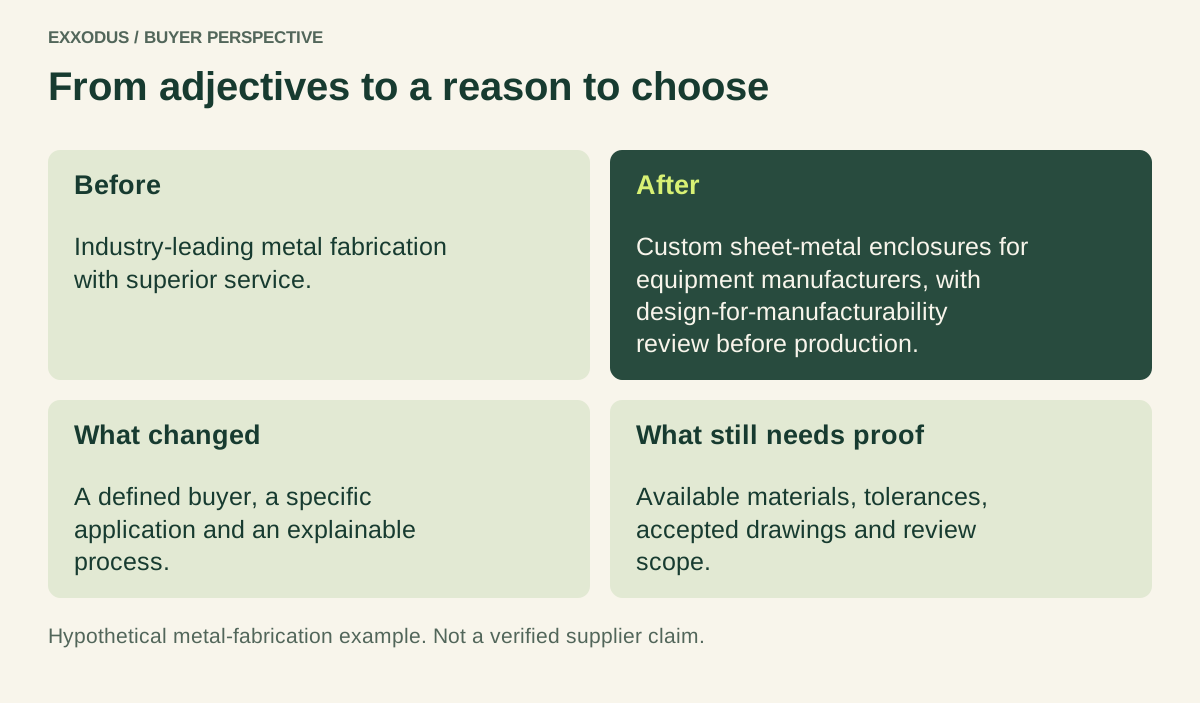
Before: “Industry-leading metal fabrication with superior service.” After: “Custom sheet-metal enclosures for equipment manufacturers navigating material selection, bend geometry, and assembly constraints, with design-for-manufacturability feedback before production.”
This hypothetical rewrite identifies the buyer, the application, and a relevant capability. It does not claim that every design is feasible or promise an unverified turnaround time.
The supporting page should answer what materials and processes are available, which drawing formats are accepted, what tolerances require discussion, and how the review proceeds. The headline cannot carry the entire burden. It opens the right conversation; the details make it credible.
Example two: packaging production
Before: “Innovative packaging tailored to your needs.” After: “Custom printed flexible packaging for regional food producers managing multiple SKUs, with material and print options aligned to their packaging formats and production requirements.”
This is an illustrative positioning exercise, not a description of a verified supplier. The distinction is the customer fit and the practical scope of the offering, not an instruction to request samples.
Notice that the rewrite avoids “fastest,” “lowest cost,” and other claims requiring comparative proof. If your actual differentiator is a validated barrier property, explain the test method and conditions.
If it is your team’s experience with artwork transitions, show the process and relevant constraints. Precision beats enthusiasm when procurement starts asking questions.
Example three: industrial machinery
Before: “Advanced automation solutions for maximum productivity.” After: “Case-packing equipment for manufacturers integrating automated end-of-line operations, with application-specific product handling, changeover planning, and installation support.” This gives engineering and operations a clearer reason to assess fit without turning the value proposition into a checklist of tasks or a sales invitation.
A machine can be impressive without being right for the line. Show the applicable product range, utilities, footprint considerations, integration dependencies, and training expectations where appropriate.
Never translate an untested feature into a percentage improvement. Marketing does not get to manufacture the measurements just because the machine manufacturer has not supplied them.
Build a proof-backed value proposition
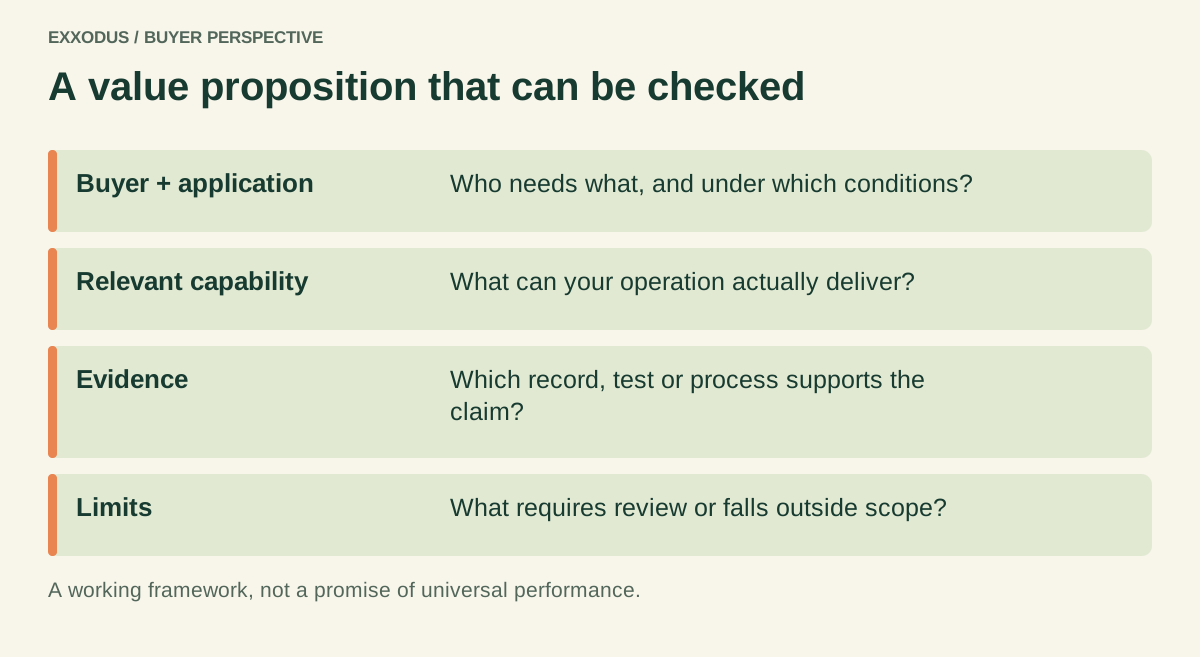
Use this working template: “For [specific buyer and application] facing [important problem or constraint], we provide [relevant capability or approach] so they can [practical decision or outcome], supported by [verifiable evidence].” It is a drafting tool, not necessarily the sentence you should publish verbatim. Your website copy should sound like a human explaining a real business.
For every important claim, identify the evidence you can actually provide. Process claims might be supported by a walkthrough or technical explanation. Capability claims need specifications and limits.
Outcome claims need a credible baseline, timeframe, and measurement method. Customer results need permission and context. If the evidence is unavailable, narrow the claim rather than making the type bigger.
Create a simple evidence register with five columns: claim, audience, proof, owner, and review date. An engineering manager may own the technical limits; quality may confirm certifications; sales may know which customer examples are approved. This small operational habit prevents the homepage from advertising a capability that production stopped offering two years ago.
Different people need different reasons to care
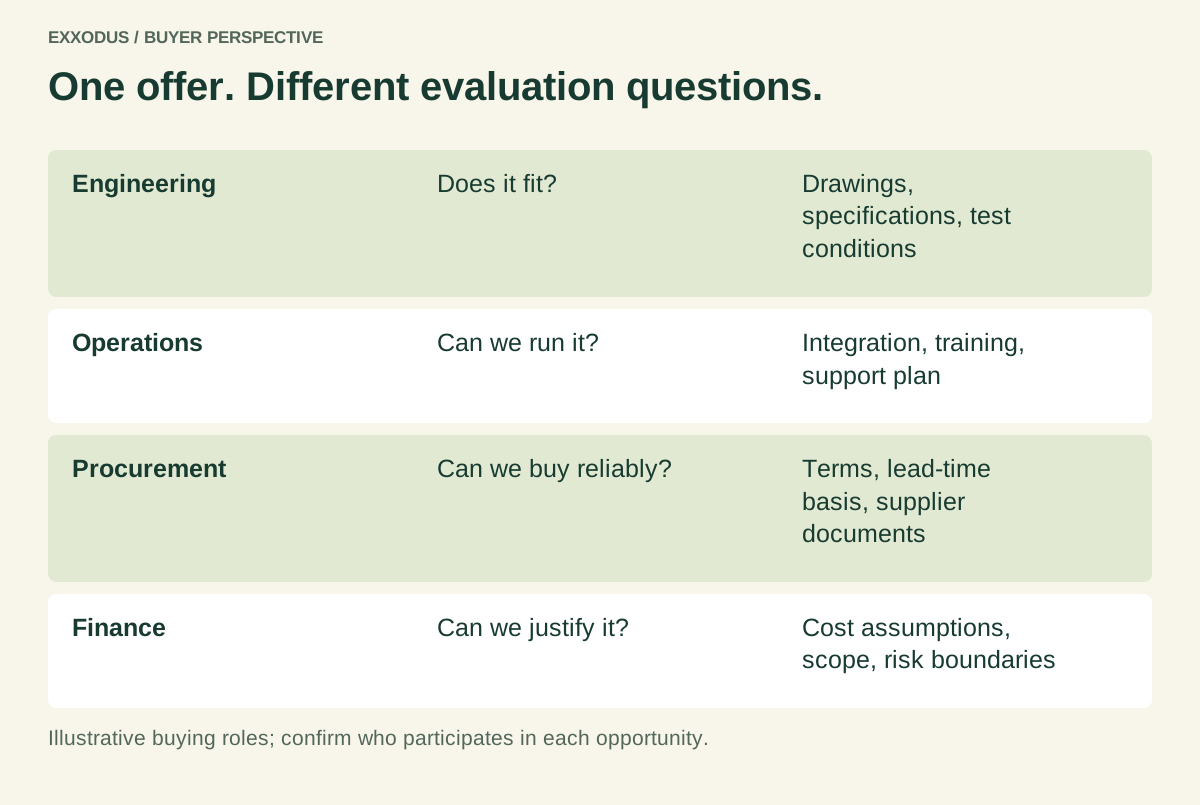
An engineer wants technical fit and evidence. Operations may care about changeovers, installation, and support. Procurement needs to evaluate supplier requirements, commercial terms, and risk.
A finance stakeholder may need to understand the assumptions behind the business case. The same value proposition should remain consistent, but the supporting explanation can change by role.
For example, “helps simplify changeovers” is not enough for an engineering reviewer. Which adjustments? Under which conditions?
Does the statement concern setup steps, training, tooling, or measured time? For a procurement reviewer, explain documentation and supplier onboarding.
For operations, describe who does what during installation. One company, several legitimate questions.
Put the proposition where buyers can test it
Start with the homepage headline and opening paragraph, then extend the same promise into relevant capability and application pages. The homepage tells buyers where they are. The capability page shows what you can do.
The application page explains fit for a use case. A case study or technical example provides supporting evidence. The request-for-quote path explains how to proceed.
A disconnected message is expensive. If the homepage promises flexible project support while the RFQ page requires complete final drawings before any conversation, the buyer has to guess what “flexible” meant.
Review the full path as one experience. The point is not to repeat a slogan five times; it is to make each page support the same truthful position.
Google recommends original, helpful content that gives readers substantive information rather than material written primarily to manipulate search results 2. That is a sensible editorial standard here too. Use the phrase “manufacturing value proposition” where it helps the reader understand the topic, but do not stuff it into sentences that already work without it.
Test the message with actual buyers and salespeople
Show a draft to someone unfamiliar with your company and ask three questions: What do we make or do? For whom? What would you check next to decide whether we fit?
If the reader answers with “you seem innovative,” you have learned very little. If they can describe the application and next step, the message is doing more work.
Then test the copy with sales and technical colleagues. Does it attract the inquiries you want? Are the claims accurate?
Which questions remain unanswered? Compare suitable inquiries and objections over time, but do not attribute every change in pipeline to one headline. Pricing, capacity, timing, and market demand still exist outside the copywriter's laptop.
A practical 30-minute workshop
Choose one profitable customer segment and one recurring application. Write down the buying trigger, two important constraints, three capabilities that genuinely matter, and one proof item for each capability. Draft a two-sentence value proposition.
Remove every adjective that cannot be demonstrated. Read it aloud to an engineer and a salesperson. Revise until both recognize the business.
Then identify the page where the new message belongs and the document that should substantiate it. A value proposition without supporting proof is a promise waiting for an awkward follow-up email.
You do not need to rewrite the entire website on day one. Start where the buyer is most likely to encounter the claim.
When differentiation is not a dramatic product feature
Some suppliers do not have a patented process, unusual machine, or spectacular performance metric. That does not mean they have nothing meaningful to say. A buyer may value dependable documentation, thoughtful feasibility screening, clear escalation paths, or a well-defined handoff between engineering and production.
Those benefits are only differentiators when they are relevant, delivered consistently, and supported by evidence. They should not become empty substitutes for “quality.”
Suppose two fabricators can both produce the required component. One explains which drawing details it needs to assess feasibility, how it communicates design questions, and what happens before a quote is finalized. The other offers a generic contact form and a promise to respond soon.
The first company has made its process easier to evaluate, even if neither supplier can credibly claim to be the best in the market. This is communication creating commercial value without inventing a technological advantage.
What to avoid when writing manufacturing differentiation
Avoid promising speed without stating what the clock measures. Is the number about initial response, engineering review, prototype delivery, or production lead time? Avoid calling a product sustainable without explaining the material, boundary, evidence, and relevant trade-offs.
Avoid using certifications as proof of outcomes they do not establish. And avoid turning a customer's isolated result into a universal expectation for every application.
Equally important, do not write your proposition around a competitor you have barely studied. “Unlike other suppliers, we care about our customers” is both difficult to substantiate and faintly ridiculous. Research competing offers, but focus your public message on your own fit and proof.
The goal is not to win an adjective contest. It is to help a buyer compare realistic options without needing a decoder ring.
Frequently asked questions
What makes a good value proposition for manufacturers?
A good one identifies a suitable buyer, a meaningful problem or requirement, a relevant capability, and a credible reason to believe the company can deliver. It is specific enough to help buyers decide whether to investigate further.
Is a value proposition the same as a unique selling proposition?
They overlap, but the value proposition emphasizes the benefit and fit for the buyer. A unique selling proposition often emphasizes a distinction from competitors. A difference matters only if it changes something the customer values.
Can a manufacturer have more than one value proposition?
Yes. Different applications or customer groups may need distinct supporting propositions. Keep them consistent with the company's real capabilities rather than presenting five unrelated identities.
Make the difference easy to understand
Open your homepage and cover the logo. Could a relevant buyer tell what kind of work you are equipped to do, and why they should continue reading? If the answer depends on a salesperson explaining the page afterward, you have found a communication problem worth solving.
A value proposition and a call to action have different jobs. The proposition explains the relevant fit and why it matters; a page can separately provide a path to request specifications, discuss feasibility, or obtain a quote. Keep those elements distinct so the central promise remains clear.
A strong value proposition does not need to end in a sales pitch. It needs to make the right buyer understand the fit, recognize the evidence, and know which information to examine next. That is a much more useful outcome than another promise of excellence.
Sources
[1] NIST Manufacturing Extension Partnership, “The Small Manufacturer’s Value Proposition: The Secret Marketing Ingredient to Outshine Larger Competitors,” May 31, 2019. ↗
[2] Google Search Central, “Creating Helpful, Reliable, People-First Content.” ↗