Your website does not need another redesign just because it looks old. It does not need more pages simply because competitors have more pages. And it certainly does not need to become your “best salesperson working 24/7.”
Your salespeople would probably object to that job description anyway. A B2B website strategy should answer a more useful question:
What does a buyer need to understand, evaluate and believe before deciding to move forward with our company, and how should the website help make that happen? That distinction changes almost everything. Instead of starting with:
- colors,
- templates,
- animations,
- page counts,
- CMS platforms,
- or CTA button copy,
you start with the decision the buyer is trying to make. Because a B2B website is not simply something a company owns. It is part of the environment in which buyers investigate that company.
Potential customers may visit it before speaking with sales. They may return after a sales call. They may send one page to an engineer and another to finance.
They may compare it with three competitors. They may arrive from Google, LinkedIn, an industry publication, an AI assistant, a trade show conversation or a colleague's recommendation. And many will leave without filling out a form.
That does not automatically mean the website failed. The more useful question is:
Did the website help them make progress? That is the foundation of a strong B2B website strategy.
What Is a B2B Website Strategy?
A B2B website strategy is the plan for how a company's website will help business buyers discover, understand, evaluate and trust the company, and take appropriate next steps throughout a complex buying process. It connects:
- business strategy
- target market
- positioning
- buyer needs
- messaging
- information architecture
- content
- SEO
- proof
- conversion paths
- sales enablement
- analytics
Web design determines how the site looks and behaves. Website strategy determines why the site exists, whom it needs to serve and what work it must help buyers accomplish.
B2B Website Strategy vs. Web Design
The distinction matters because companies frequently jump directly into redesign projects. They discuss:
- branding
- layouts
- animations
- imagery
- CMS
- page templates
- navigation styles
before resolving more basic questions.
| Website strategy | Web design |
|---|---|
| Who must the site serve? | How should the interface look? |
| What do buyers need to understand? | How should information be visually presented? |
| What evidence do they require? | How should components be arranged? |
| How should information be organized? | How should users interact with the interface? |
| What should each page accomplish? | How should that page be visually executed? |
| How does the site support sales? | How should the experience feel? |
| What should be measured? | How should design support those objectives? |
Design matters. But design cannot answer strategic questions that were never resolved.
The Website's Job Is Buyer Progress, Not Just Conversion
A common B2B website philosophy says every page should push visitors toward conversion. There is some truth in that. There is also a problem.
Not every valuable visitor is ready to:
BOOK A DEMO or CONTACT SALES
or REQUEST A QUOTE today.
Imagine an engineer researching a technical approach six months before a project receives funding. A VP comparing potential partners before an internal strategy meeting. A procurement professional verifying a supplier recommended by operations.
A CFO opening a case study forwarded by someone else. A hidden stakeholder checking your company after the buying team has already shortlisted it. None may submit a form.
All may influence revenue. So instead of forcing every page toward the same conversion, a strong B2B site should create appropriate progression. That might mean helping someone:
- understand an unfamiliar problem
- explore an application
- compare approaches
- read specifications
- evaluate expertise
- see customer proof
- understand implementation
- validate risk
- share information internally
- contact an expert
- request pricing
- begin an RFQ
Conversion is one form of progress. It is not the only one.
Why the B2B Website Matters Before Sales Ever Sees the Buyer
B2B buying groups often form preferences before engaging vendors directly. The 2025 6sense Buyer Experience Report studied nearly 4,000 B2B buyers across North America, APAC and EMEA. The research found that:
- 95% of purchases went to a vendor already present on the buyer's Day One shortlist
- 94% of buying groups had ranked their shortlist before speaking with sellers
- buyers initiated the first seller engagement 79% of the time
- the favored vendor before seller engagement ultimately won approximately 77% of purchases
- the average point of first seller contact occurred approximately 61% through the buying journey
Source: 6sense, 2025 B2B Buyer Experience Report.
The sample spans multiple B2B industries; these findings should not be treated as universal behavior in every market. The strategic implication, however, is important. If buyers are forming supplier preferences before sales conversations, the information they encounter independently matters.
Your website is part of that environment.
Buyers Do Not Visit Your Website in Isolation
A website is only one touchpoint. A buyer may:
- encounter a company on LinkedIn,
- ask a colleague about it,
- search the company name,
- visit the homepage,
- leave,
- read an industry article,
- ask an AI assistant to compare alternatives,
- return directly to a solution page,
- send a case study to finance,
- speak with sales,
- return to technical documentation,
- and eventually request a proposal.
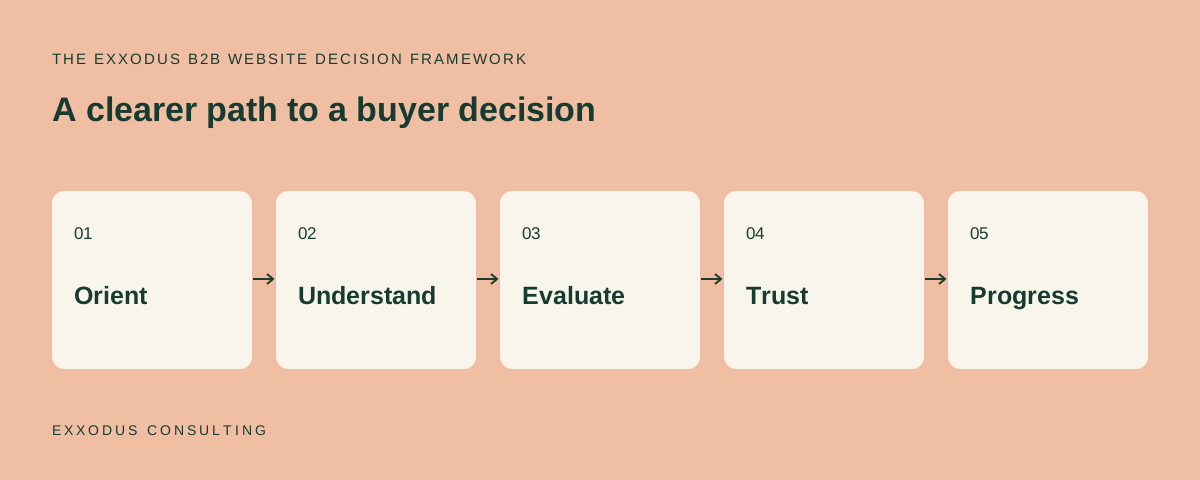
Trying to attribute the entire journey to the final CTA misses what the website actually did. The website helped the buyer orient, understand, evaluate, trust and progress. That is the model we use.
The Exxodus B2B Website Decision Framework
A strong B2B website should help buyers accomplish five jobs:
ORIENT
Am I in the right place? The visitor should quickly determine:
- what the company does
- who it serves
- whether the offer appears relevant
- where to go next
UNDERSTAND
What exactly does this company help with? The site should make products, services, problems and value understandable without requiring insider knowledge.
EVALUATE
Could this work for our specific situation? The buyer needs enough depth to assess fit.
TRUST
Why should we believe this company can deliver? Claims require proof.
PROGRESS
What should we do next? The site should provide an appropriate next step based on the visitor's information needs and buying stage. These five jobs provide a more useful framework than:
homepage → product page → Book a Demo because real B2B decisions rarely move that neatly.
1. ORIENT: Help Buyers Know Where They Are
The first job of a B2B website is surprisingly basic:
reduce uncertainty. When someone arrives, they should not have to decode brand language to determine what the company actually does. Weak B2B messaging often sounds like:
Transforming possibilities into tomorrow's solutions. Innovation without limits. Accelerating your digital future.
These statements may sound polished. They also communicate very little. Orientation requires clarity around:
- category
- audience
- problem
- offering
- context
You do not need to explain the entire company above the fold. You do need to give the visitor enough orientation to decide whether continuing is worthwhile.
Homepage Messaging Should Answer the First Decision
The homepage does not need to explain everything. Its job is to establish enough relevance to route the buyer correctly. A visitor should quickly be able to determine:
What is this company?
Who is it for?
What type of problem does it solve?
Why might it be relevant to us?
Where should I go next?
That last question is particularly important. A homepage should route, not trap.
2. UNDERSTAND: Translate the Company Into Buyer Language
Companies naturally organize themselves around internal structures. Business units. Departments.
Product families. Service practices. Technologies.
Buyers may not think in those categories. They may arrive thinking:
We need to reduce downtime. We're entering the U.S. market. We need a packaging supplier that can handle this material.
We need software that integrates with our ERP. Our sales materials no longer explain what we actually do. Your site's architecture and messaging need to bridge the gap between:
how the organization sees itself and how the buyer frames the problem.
Information Architecture Is a Strategic Decision
Information architecture determines:
- what content exists
- how it is grouped
- how it is labeled
- how visitors move between topics
- how different audiences find relevant information
A B2B site's structure might organize information by:
- product
- service
- industry
- application
- problem
- role
- market
- resource type
There is no universally correct hierarchy. The right structure depends on how buyers look for answers.
Do Not Build Navigation Around Your Org Chart
Internal organization creates familiar navigation problems. Marketing wants one menu. Product wants another.
Sales wants industries. Leadership wants corporate pages. Everyone needs their department represented.
The final navigation reflects organizational politics rather than buyer logic. Instead, ask:
What is the visitor trying to find? and Which path requires the least interpretation?
The website should not require buyers to understand the company before they can navigate it.
3. EVALUATE: Give Buyers Enough Depth to Assess Fit
Once buyers understand what you do, another question appears:
Will this work for us? This is where many B2B websites become frustratingly shallow. The homepage may look excellent.
The service page contains six polished paragraphs. But the actual evaluation information lives:
- in sales presentations
- inside PDFs
- in engineers' heads
- in proposals
- in customer calls
- in internal documentation
The website stops precisely when the buyer becomes interested.
Evaluation Content Depends on the Purchase
Depending on the offer, buyers may need:
- capabilities
- specifications
- use cases
- technical requirements
- integrations
- methodologies
- deliverables
- timelines
- applications
- compatibility
- pricing approach
- implementation process
- service model
- geographic coverage
- limitations
- comparisons
Do not publish information merely because competitors do. Identify what buyers actually need to determine fit.
Product Pages and Service Pages Need a Job
A good B2B product or service page should not simply describe the offer. It should support a decision. Possible questions include:
What problem does this address?
Who is it designed for?
What does it include?
How does it work?
What situations is it best suited for?
What does implementation involve?
What evidence supports the claims?
What should someone do next?
The exact answers vary. The decision logic does not.
Different Stakeholders Need Different Evidence
B2B buying is rarely a single-person activity. The 2025 Edelman–LinkedIn Thought Leadership research highlights the role of hidden buyers: stakeholders from areas such as finance, legal, operations, compliance and procurement who may influence a purchase while remaining largely invisible to marketing. LinkedIn reports that:
- 64% of target buyers spend more than one hour per week consuming thought leadership
- 63% of hidden buyers do the same
- 56% of target buyers use thought leadership during vendor evaluation
- 55% of hidden buyers do so
Source: LinkedIn / Edelman, 2025 B2B Thought Leadership Impact research.
A website therefore cannot be designed exclusively for the person who filled out the form. Someone else may arrive later with completely different questions.
Build for the Buying Group, Not Only the Persona
A technical buyer may need:
- specifications
- methodology
- integrations
- technical proof
A commercial stakeholder may need:
- ROI
- pricing logic
- scalability
- business outcomes
Procurement may need:
- credentials
- supplier information
- geographic coverage
- risk evidence
Leadership may need:
- strategic relevance
- customer proof
- credibility
- expected business impact
This does not mean creating four versions of every page. It means ensuring the website contains enough information for the buying group to evaluate the company collectively.
4. TRUST: Build a Proof Architecture
Many B2B sites have testimonials. Fewer have a deliberate proof architecture. Trust is not one carousel halfway down the homepage.
It accumulates across the site. Potential evidence includes:
- case studies
- customer outcomes
- certifications
- client logos where permitted
- technical expertise
- methodology
- data
- customer quotes
- awards
- subject-matter experts
- processes
- guarantees
- security information
- research
- third-party validation
- transparent limitations
Which proof matters depends on the purchase.
Evidence Should Sit Near the Claim
If a page says:
Our process reduces implementation time show evidence nearby. If it says:
Trusted by global manufacturers demonstrate that credibility. If it says:
Deep technical expertise show the expertise. One of the simplest principles in B2B website communication is:
The stronger the claim, the closer the proof should be.
Do not make buyers hunt for evidence.
Case Studies Are Decision Tools, Not Trophy Cabinets
A case study should not merely say:
Customer had problem. We helped. Customer was happy.
Useful case studies help another buyer understand:
- context
- challenge
- constraints
- approach
- reasoning
- implementation
- result
- relevance
The objective is not simply social proof. It is helping buyers imagine what working with your company would actually involve.
Expertise Should Be Visible
B2B companies frequently hide their smartest people. The website talks in a generic corporate voice while the subject-matter experts are buried three layers deep on LinkedIn. That is backwards.
Expertise can appear through:
- author profiles
- technical articles
- commentary
- webinars
- videos
- research
- interviews
- methodology explanations
Especially as AI makes generic content cheaper to produce, identifiable expertise becomes more valuable.
5. PROGRESS: Give Buyers the Right Next Step
This is where website strategy intersects with conversion strategy. But instead of asking:
What one action should every visitor take? ask:
What is the most useful next action for this visitor at this moment? Examples include:
- explore an application
- compare solutions
- read a case study
- review technical documentation
- calculate ROI
- download specifications
- see pricing
- contact an expert
- request an assessment
- request a quote
- book a consultation
- find a distributor
Different pages can support different forms of progress.
Not Every CTA Has to Be a Form
A link can be a CTA. So can:
See how this works Compare approaches Explore applications
Read the case study View specifications A CTA is simply an intentional next step.
Lead capture is only one category.
Stop Designing Only for the Bottom of the Funnel
A website built almost entirely around:
Contact Sales assumes the buyer has already answered every other question. Often they haven't.
A stronger site includes paths for:
- exploration
- education
- comparison
- validation
- commercial action
That allows buyers to progress without pretending everyone is ready for the same conversation.
How to Build a B2B Website Strategy
The framework above describes what the buyer needs. The following process describes how to build the strategy.
Step 1: Start With the Business Strategy
Before discussing pages, determine what the site needs to support. Examples:
- entering a new market
- repositioning the company
- launching a new product
- increasing enterprise sales
- supporting distributors
- expanding into a new vertical
- generating qualified inquiries
- shortening sales cycles
- increasing organic visibility
- supporting international expansion
Different business strategies require different websites.
Step 2: Define the Priority Audience
Identify:
- ICP
- industries
- account characteristics
- buyer roles
- geographic markets
- buying situations
Do not attempt to give every possible audience equal prominence. Strategy requires prioritization.
Step 3: Research Real Buyer Questions
Use:
- sales calls
- CRM data
- customer interviews
- RFQs
- support conversations
- Search Console
- keyword research
- website search data
- proposals
- win/loss analysis
- sales emails
Look for recurring questions such as:
- What exactly do you do?
- Can you support our specific situation?
- What does implementation involve?
- How are you different?
- What does this cost?
- Who have you worked with?
- What proof do you have?
- How long will this take?
- What happens next?
These questions should shape the site.
Step 4: Audit the Existing Website Before Redesigning It
Never assume everything needs replacement. Review:
Traffic
Which pages already attract qualified visibility?
Search performance
Which queries and pages already rank?
Conversion behavior
Which paths produce meaningful commercial actions?
Content
Which information is useful, outdated, missing or redundant?
Sales usage
Which pages does sales actually send?
Buyer friction
Where do people struggle to find information?
Technical health
Speed, mobile behavior, crawlability, accessibility, broken links and structured data. Protect what already works. A redesign that destroys valuable search equity is not progress.
Step 5: Establish Positioning Before Copywriting
Website copy cannot rescue unclear positioning. Define:
- who the company is for
- what problem it solves
- which category it belongs to
- where it is particularly strong
- why that matters
- what evidence supports it
Then translate that positioning into website messaging.
Step 6: Map Buyer Decision Requirements
For each major buyer or stakeholder, identify:
- what they need to understand
- what they need to evaluate
- what they need to trust
- what might stop the decision
- what they may need to share internally
This creates the information requirements for the site.
Step 7: Design the Information Architecture
Now decide how information should be grouped. Possible page families include:
- Products
- Services
- Solutions
- Industries
- Applications
- Use Cases
- Resources
- Customer Stories
- Company
- Contact
Do not use every category automatically. Create the structure buyers need.
Step 8: Build a Page-Level Content Model
Every important page should have an explicit job. For example:
Homepage
Orient and route.
Service page
Explain value and evaluation criteria.
Industry page
Demonstrate contextual relevance.
Product page
Support technical and commercial evaluation.
Case study
Build confidence and proof.
Article
Educate, attract search demand and establish expertise.
About page
Establish organizational credibility.
Contact page
Remove friction from commercial action. A page should exist because it helps accomplish something. Not because the sitemap looked empty.
Step 9: Build Search Visibility Into the Architecture
SEO should not be bolted on after the site is designed. Search research can influence:
- navigation
- page hierarchy
- terminology
- product pages
- industry pages
- application pages
- resource strategy
- URL structure
- internal links
For example, if buyers search heavily by application but your site only organizes information by internal product family, you may be creating both usability and SEO problems.
B2B Website SEO Is More Than a Blog
A common mistake is putting the entire SEO strategy into the blog. Commercial pages can target meaningful search demand too. Depending on the business:
- product pages
- service pages
- industry pages
- application pages
- comparison pages
- location pages
- technical resources
may carry stronger commercial intent than informational articles. Content strategy and commercial architecture should work together.
AI Search Changes Discovery, Not the Need for a Website
AI-driven research has created a strange prediction:
“People won't need websites anymore.” Current buyer behavior does not support abandoning the site. 6sense's research found that although LLM use is widespread among its surveyed B2B buyers, in-market buyers continue to engage vendor websites.
The research also found an important gap:
buyers often needed information about vendor AI capabilities, pricing, implementation, data security and related questions that vendor websites did not clearly provide. As a result, buyers sometimes had to engage sellers earlier simply because the website did not answer the questions.
Source: 6sense, 2025 B2B Buyer Experience research and related analysis on GenAI/LLM buyer research.
The lesson is not:
optimize for AI instead of humans. It is:
publish information clearly enough that humans, search engines and AI systems can understand what the company is credible about.
SEO, AEO and AI Visibility Should Share the Same Foundation
Useful foundations include:
- clear page purpose
- descriptive headings
- direct answers
- strong entity relationships
- consistent terminology
- original expertise
- evidence
- structured information
- helpful internal linking
- crawlable content
- proper structured data where relevant
Do not create unreadable content purely to impress an answer engine. If information is genuinely clear and authoritative, it is already moving in the right direction.
Step 10: Design Conversion Paths Around Intent
Conversion architecture should consider:
- visitor intent
- page role
- buying stage
- offer complexity
- sales process
- commercial value
Possible conversions include:
High intent
- request proposal
- book consultation
- request demo
- request quote
Medium intent
- contact specialist
- request technical information
- compare options
- complete assessment
Lower immediate intent
- explore related topic
- read case study
- view guide
- subscribe
Not every business needs every type.
Step 11: Connect the Website to Sales
Ask sales:
- Which pages do you send prospects?
- Which pages do you wish existed?
- What questions do buyers ask repeatedly?
- What objections delay deals?
- Which competitor pages do buyers mention?
- What information is always sent manually?
If sales continually sends the same PDF because the site does not contain usable information, that is a website-strategy signal. The website should not replace sales. It should eliminate unnecessary explanation so sales can focus on conversations where human expertise matters.
Step 12: Decide What the Website Should Measure
A B2B website needs more than traffic metrics. Useful categories include:
Visibility
- organic impressions
- priority keyword visibility
- branded search
- relevant referral traffic
- AI/search visibility where measurable
Engagement
- meaningful page progression
- technical-document use
- case-study consumption
- returning visitors
- account-level engagement
Commercial intent
- quote requests
- consultation requests
- demo requests
- qualified forms
- contact actions
Pipeline
- opportunities influenced
- opportunities sourced
- target-account activity
- pipeline generated
- revenue influenced
Strategic learning
- internal search terms
- pages used by sales
- recurring questions
- content gaps
- exit patterns
- conversion-path friction
Do not automatically optimize for whichever metric is easiest to see in Google Analytics.
What Pages Should a B2B Website Have?
There is no universal sitemap. But most B2B sites should evaluate whether they need the following categories.
Homepage
Purpose:
Orient and route. Not:
explain everything the company has ever done.
Product or Service Pages
Purpose:
Help buyers understand and evaluate the offer. These are often among the most commercially important pages on the site.
Industry Pages
Use these when industry context genuinely changes:
- problems
- terminology
- proof
- use cases
- requirements
- buying concerns
Do not create dozens of thin pages by swapping industry names in the headline.
Application or Use-Case Pages
These can be particularly useful for complex B2B or industrial companies because buyers often search by the job they need to accomplish.
Case Studies
Purpose:
Demonstrate relevant evidence. Organize them so buyers can find examples related to:
- industry
- use case
- problem
- product
- outcome
where appropriate.
Resource Center
A useful resource hub may include:
- articles
- guides
- research
- videos
- technical documents
- webinars
- tools
Structure it for discovery rather than creating a dumping ground called “Resources.”
About Page
The About page is often underestimated in B2B. Buyers evaluating an unfamiliar company may want to know:
- who you are
- how established you are
- where you operate
- who leads the organization
- what expertise exists
- why the company is credible
This page is part of trust-building.
Contact Page
Make it easy. Do not request twelve fields because someone once told you more fields mean better qualification. Collect what sales genuinely needs to respond appropriately.
B2B Website Messaging: Clarity Before Cleverness
A clever headline that requires explanation has already created work for the buyer. Strong messaging usually clarifies:
Audience Who is this relevant for? Problem
What situation does the company address? Value What changes for the buyer?
Differentiation Why this approach? Proof
Why believe it? The exact combination varies by page. The principle does not.
B2B Website Content Strategy
A website content strategy should support three broad information jobs:
Discover
Content that helps buyers find the company. Examples:
- SEO articles
- category education
- problem-focused content
Evaluate
Content that helps buyers investigate fit. Examples:
- solution pages
- product pages
- comparison guides
- technical resources
- implementation information
Validate
Content that helps establish confidence. Examples:
- case studies
- proof
- certifications
- methodology
- customer results
- expertise
Some content can perform more than one job.
How a B2B Website Supports Sales Enablement
The site should also help sellers. A strong website gives sales reusable destinations for:
- explaining services
- proving capability
- sharing customer outcomes
- answering technical questions
- discussing implementation
- reassuring hidden stakeholders
Instead of sending a pile of PDFs, sales can send buyers into an information environment designed to support the conversation. That makes the website commercial infrastructure rather than merely a marketing asset.
What Should You Fix Before Redesigning a B2B Website?
Not every problem requires a redesign. Sometimes the site needs:
- stronger messaging
- different navigation
- better proof
- missing service pages
- better internal links
- technical SEO fixes
- improved CTAs
- updated case studies
- stronger content
A complete rebuild makes sense when deeper structural problems exist. Examples:
- positioning has changed
- architecture no longer supports the business
- CMS prevents growth
- brand and site are badly misaligned
- technical debt is significant
- multiple acquisitions created incoherent architecture
- international expansion requires major restructuring
Diagnose first. Redesign second.
Common B2B Website Strategy Mistakes
1. Starting With Design
A beautiful answer to the wrong question is still the wrong answer.
2. Copying Competitor Navigation
You can see their site. You cannot see whether their site works.
3. Organizing Everything Around the Company
Buyers do not care which internal department owns the service.
4. Sending Everyone to “Book a Demo”
Different levels of intent require different next steps.
5. Hiding Useful Information Behind Forms
Some information is more valuable when buyers can actually use it. Gate strategically. Not reflexively.
6. Treating the Homepage as the Entire Website
Many buyers enter through deeper pages. Every important landing page should orient them.
7. Publishing Thin Industry Pages for SEO
Changing five words does not create useful industry expertise.
8. Treating SEO as a Blog Project
Commercial pages need search strategy too.
9. Using Testimonials as the Entire Proof Strategy
Trust requires more than praise.
10. Measuring All Visitors the Same Way
One hundred irrelevant visitors and ten target-account visitors are not commercially equivalent.
11. Ignoring Sales
Sales hears questions the website should often answer.
12. Redesigning Without Protecting Existing SEO
Never throw away working search equity casually.
13. Measuring Success Only Through Forms
Some of your most important buyers may never submit one.
How Do You Know If Your B2B Website Strategy Is Working?
Return to the five buyer jobs.
ORIENT
Can visitors tell quickly whether the company is relevant? Look at:
- homepage behavior
- navigation
- user testing
- qualitative feedback
UNDERSTAND
Can people accurately explain what the company does? Review:
- sales feedback
- customer interviews
- page engagement
- search behavior
EVALUATE
Can buyers find the information required to assess fit? Monitor:
- solution-page progression
- product engagement
- documentation
- internal search
- content gaps
TRUST
Are visitors encountering meaningful proof? Review:
- case-study usage
- sales usage
- validation content
- buyer feedback
PROGRESS
Can visitors take a useful next step? Measure:
- path completion
- qualified conversions
- sales interactions
- deeper content consumption
- pipeline influence
A B2B website succeeds when it makes good buying easier.
A Simple B2B Website Strategy Example
Imagine a specialized engineering company wants to expand into larger manufacturing accounts. A weak website brief might say:
We need a modern site that generates more leads. That gives designers almost no strategic information. A stronger brief could look like this:
Business Goal
Increase qualified opportunities from U.S. manufacturers with 200–1,000 employees.
Priority Buyers
Operations leaders, engineering leaders and plant management.
Orientation Requirement
Visitors must immediately understand the company's engineering specialization and the manufacturing environments it supports.
Understanding Requirement
Service pages need to explain capabilities in buyer terminology rather than internal department names.
Evaluation Requirement
Buyers need information about process, technical expertise, project types, implementation and industries.
Trust Requirement
The site needs detailed case studies, engineer profiles, certifications and evidence of relevant outcomes.
Progress Requirement
Early researchers should be able to explore capabilities and case studies. Higher-intent buyers should be able to contact an engineer or request a project consultation.
Search Strategy
Build visibility around technical problems, engineering capabilities and industry-specific searches rather than focusing exclusively on broad company-category keywords.
Sales Integration
Sales should have relevant pages to send during active opportunities instead of relying primarily on standalone PDFs.
Measurement
Track:
- qualified target-account traffic
- technical-page engagement
- case-study usage
- high-intent conversions
- marketing-influenced opportunities
Now the designer, writer, SEO specialist, developer and sales team all know what the site must accomplish. That is website strategy.
B2B Website Strategy Is About Building a Better Decision Environment
A B2B website does not need to behave like a salesperson. It cannot negotiate. It cannot read the room.
It cannot ask an unexpected technical question. It cannot understand internal politics. Your people are better at those things.
What the website can do exceptionally well is make useful information available when your people are not there. It can help buyers:
Orient. Understand where they are and whether you are relevant. Understand.
Make sense of what you do and why it matters. Evaluate. Determine whether your offer fits their situation.
Trust. Find evidence that reduces uncertainty. Progress.
Take the next step that makes sense for them. That may result in a form submission today. Or a forwarded case study.
Or a bookmarked technical page. Or a return visit three weeks from now. Or a buying committee deciding that your company belongs on the shortlist.
Those interactions will not all appear neatly inside an attribution report. They can still matter commercially. That is why a good B2B website strategy should not begin with:
“How do we get more people to convert?” It should begin with:
“How do we make it easier for the right buyers to make a good decision?” Build that first. Then design the website around it.
Frequently Asked Questions About B2B Website Strategy
What is a B2B website strategy?
A B2B website strategy is a plan for how a website will help business buyers discover, understand, evaluate and trust a company while supporting appropriate next steps throughout the buying process. It connects business goals, buyer needs, messaging, information architecture, content, SEO, proof, conversion paths and measurement.
What makes a good B2B website?
A good B2B website makes it easy for the right buyers to understand what the company does, determine whether it fits their situation, find credible evidence and take an appropriate next step. Clear messaging, useful information, strong architecture, search visibility and relevant proof matter more than visual novelty alone.
How do you create a B2B website strategy?
Start with the business goal and priority audience, research buyer questions, audit the existing site, establish positioning, map buyer decision requirements, build the information architecture, define page roles, integrate SEO and create conversion paths appropriate to buyer intent.
How is B2B website strategy different from web design?
Website strategy determines who the site serves, what buyers need, how information should be structured and what the website should accomplish. Web design determines how those strategic decisions are translated into an interface and visual experience.
What pages should a B2B website include?
The exact sitemap depends on the business. Common page types include a homepage, product or service pages, industry or application pages, case studies, resources, About and Contact. Every page should exist for a specific buyer or business purpose.
How should a B2B website support the buyer journey?
A B2B site should provide information for different decision needs: discovering and understanding the problem, evaluating possible solutions, validating vendors and taking commercial action. Not every page should force the same conversion.
Should every B2B website page have a CTA?
Every important page should have a logical next step, but that step does not always need to be a form. A CTA may direct a visitor to specifications, an application, a case study, a comparison, an expert or a commercial conversation.
Does SEO matter for a B2B website?
Yes. SEO can make product, service, industry, application and educational content discoverable when buyers research problems and suppliers. It should influence site architecture and content planning rather than being added after the site is built.
How is AI changing B2B website strategy?
AI gives buyers another way to research categories, products and suppliers. This increases the value of clear, structured, accurate and evidence-backed information. Companies still need strong websites because buyers use them to validate vendor-specific information and assess credibility.
How often should a B2B website be redesigned?
There is no universal redesign cycle. A site should be redesigned when strategic, structural, technical or brand changes justify it, not simply because a certain number of years has passed. Continuous optimization can often solve problems without a full rebuild.
What should B2B companies measure on their websites?
Useful metrics include commercially relevant search visibility, target-account traffic, meaningful content progression, qualified conversions, sales usage, opportunity influence and pipeline. Metrics should reflect the website's strategic job rather than traffic volume alone.
Should B2B websites show pricing?
It depends on the offer, sales model and pricing complexity. Where exact pricing is impractical, companies can still reduce uncertainty by explaining pricing structure, engagement models, starting points or the factors that determine cost when commercially appropriate.