Your manufacturing website is not a corporate autobiography. Buyers do not need three paragraphs about your commitment to excellence before learning whether you can produce the component they have in mind. They need orientation, relevant capabilities, constraints, and proof.
Effective manufacturing website content makes those answers findable without reducing a complex operation to a few empty adjectives. That means giving different pages different jobs: a homepage establishes fit, a capabilities page explains processes, and an application page connects expertise to a particular manufacturing challenge. Here is how to build that information architecture and write copy that helps real people evaluate a supplier.
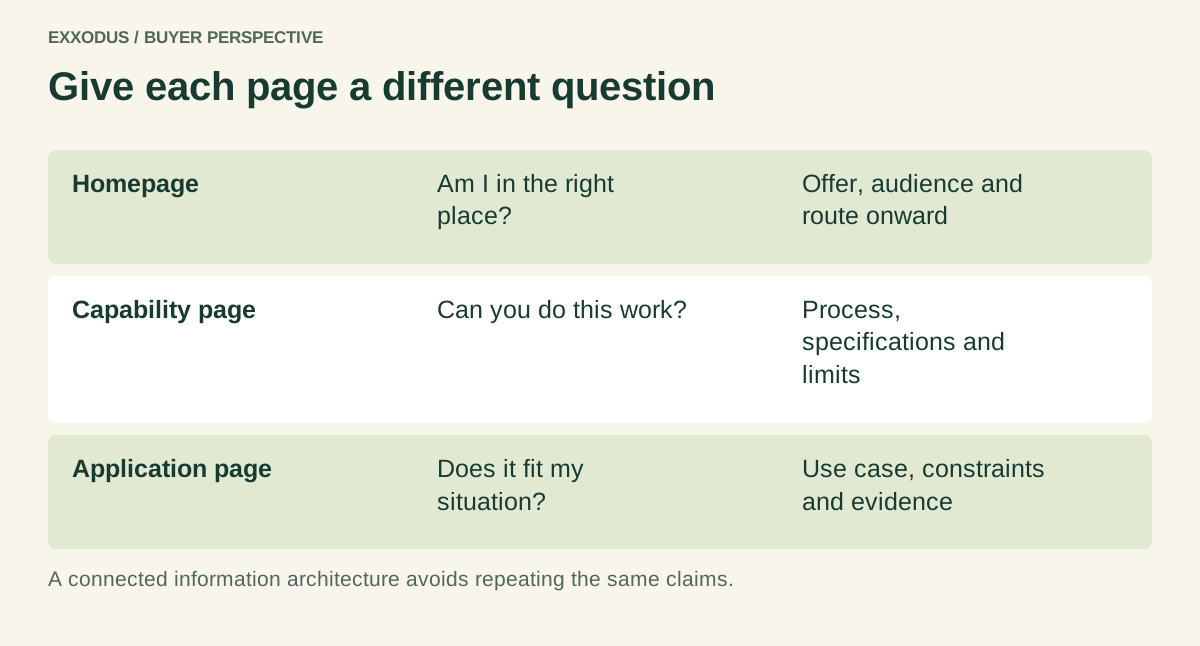
Start with the job of each page
A homepage should orient the visitor: what you make, who you serve, which applications you understand, and where to go next. A capability page should explain a process and its relevant constraints. An application page should connect that process to a buyer problem.
A quality page should explain how claims are substantiated. Mixing every job onto every page produces a dense wall of repeated claims.
Before writing, list the visitor’s question, the proof available, and the next useful page. If you cannot name those three things, you may be creating content because the navigation menu looks empty. That is not a particularly strong editorial strategy.
Write a homepage that identifies the right manufacturer
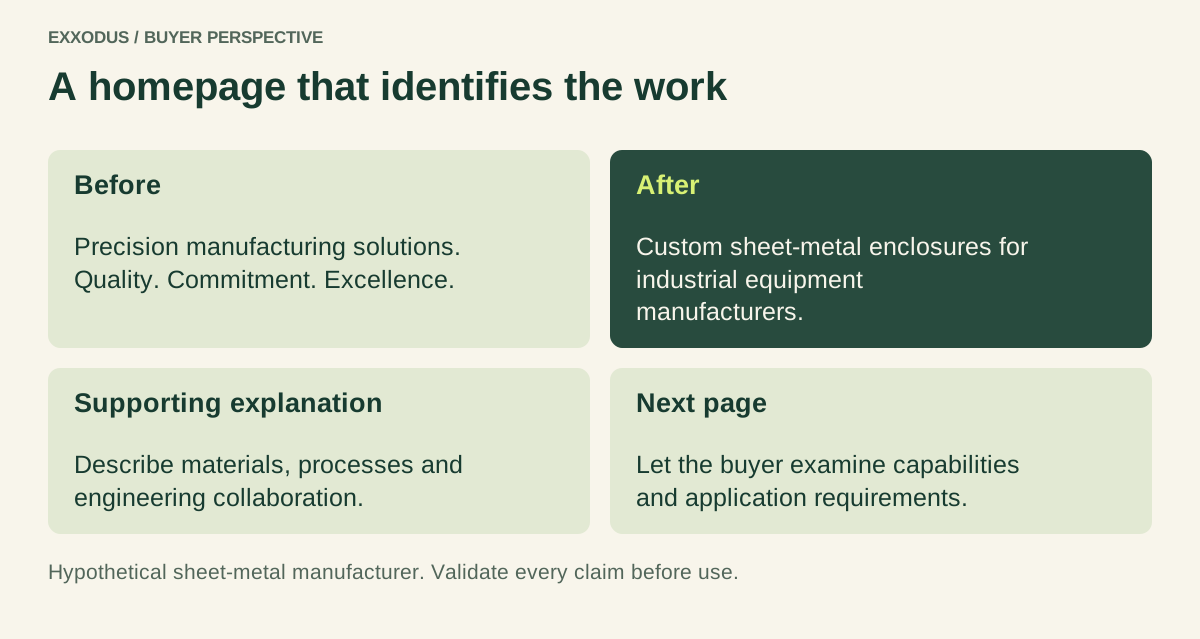
A headline such as “Precision manufacturing solutions” is compatible with thousands of suppliers. A stronger hypothetical headline might say, “Custom sheet-metal enclosures for industrial equipment manufacturers.” The supporting copy can then explain the relevant processes, engineering collaboration, and production requirements, provided those claims are true.
Your homepage does not need to reproduce every machine specification. It should let the right visitor recognize a plausible fit and find the detailed page.
Avoid promising universal speed, zero defects, or unlimited flexibility. Those claims invite questions your quality team may not appreciate answering.
Translate capabilities into evaluation criteria
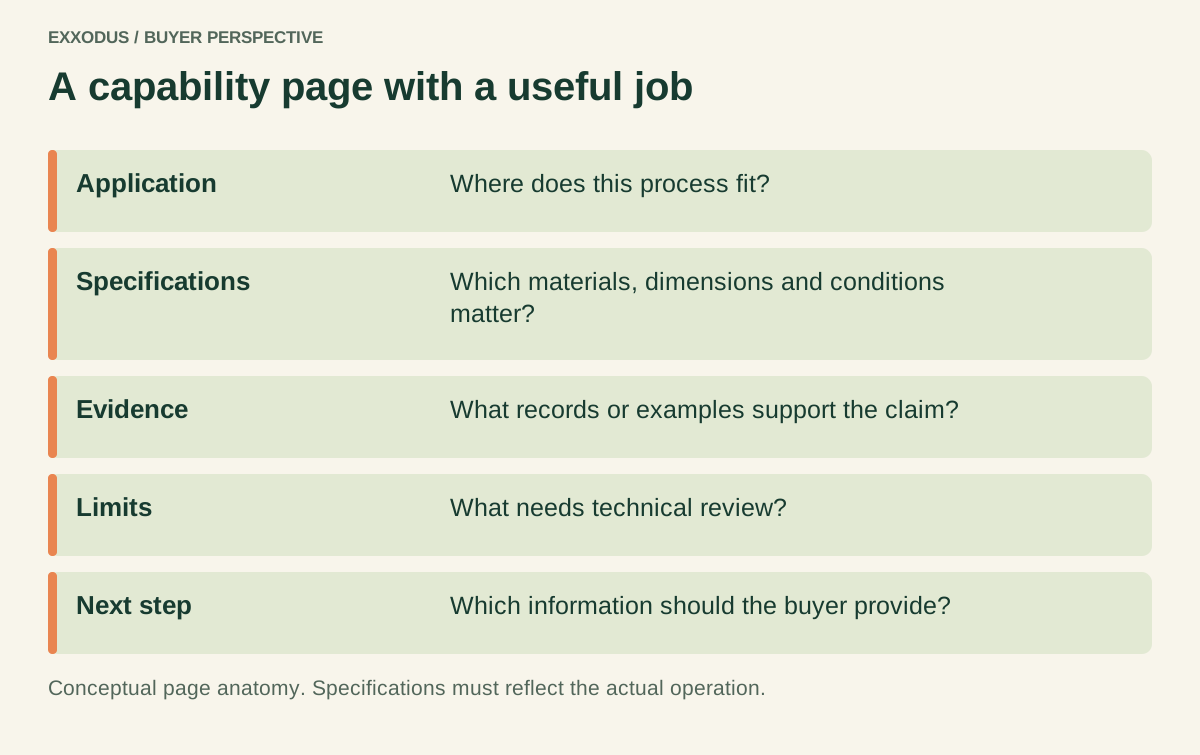
“CNC machining” names a capability; it does not tell a buyer what you can machine, to what requirements, or under which commercial conditions. A useful capability page identifies applicable materials, processes, typical project types, size ranges where approved for publication, quality checks, drawing requirements, and relevant exclusions.
For an equipment manufacturer, explain installation needs, compatible line conditions, maintenance expectations, and what must be confirmed in a technical review. If a number depends on the configuration, label it as such. The objective is not to publish a promise for every possible job; it is to help buyers ask a better question.
Show applications rather than throwing industries into a logo grid
“Serving food, medical, automotive, aerospace, and everything else” sounds expansive but says little about your experience in each context. Application pages should identify a use case, operating conditions, common constraints, and the capability that addresses them.
Be precise about certifications and compliance. Serving a regulated industry does not automatically make every product compliant with every standard.
Consider a packaging supplier: an application page for multi-SKU food products might explain artwork management, material selection considerations, line compatibility questions, and the process for reviewing samples. It should not imply suitability for food contact without the relevant substantiation and approvals.
Replace adjectives with evidence
“Reliable,” “advanced,” and “customer-focused” are conclusions. The page should show the information from which a buyer can reach those conclusions: documented inspection procedures, published certifications with scope, relevant process photographs, traceability practices, or customer-approved examples.
If you claim a capability is available, make sure the plant can actually deliver it. If you describe an inspection method, verify the terminology with quality. A copywriter should make expertise legible, not improve the technical specifications by imagination.
Make comparisons fair and helpful
A buyer may be deciding between materials, printing methods, fabrication processes, or machine configurations. Comparison content should explain the trade-offs: suitability, volume, changeover implications, tooling, constraints, and what data are needed for a proper recommendation. Avoid declaring one approach “best” without defining the conditions.
A hypothetical packaging comparison could explain that digital and flexographic printing may differ in setup economics, available materials, run profiles, and finishing requirements. The appropriate choice depends on the actual job and supplier capability. The page should help the reader narrow the decision rather than pretending every application has one universal winner.
Write contact paths for different levels of readiness
Someone with final drawings may be ready for an RFQ. Someone still evaluating feasibility may need a technical discussion.
Someone who already bought a machine may need support. One “Contact Us” button for all three audiences creates unnecessary sorting work and confusing expectations.
Keep CTAs separate from your value proposition. A value proposition explains the relevant reason to consider the supplier; a CTA offers the next step. “Custom printed flexible packaging for regional food producers managing multiple SKUs” is positioning.
“Request a material review” is an action. Both can appear on a page, but they should not be masquerading as the same sentence.
Use the language customers actually use
Technical precision matters, but internal product names may not match search behavior. Interview sales about the phrases prospects use in emails, RFQs, and calls.
Pair recognizable application language with correct technical terms. Define an acronym the first time it appears unless your intended audience can safely be assumed to know it.
Google recommends content that genuinely helps readers and demonstrates first-hand expertise. That supports a practical editorial choice: answer the question well, show what you know, and use the keyword where it naturally belongs. Repeating “manufacturing website copy” every other sentence will not make an unhelpful page useful.
Build a content-review process that does not stall forever
Assign a technical owner for each important page and agree what needs verification: specifications, claims, certifications, photographs, lead-time language, and limitations. Have sales check whether the wording matches actual customer questions. Give someone final publishing responsibility and a date for the next review.
A content inventory with page URL, audience, owner, last technical review, evidence source, and next action is enough to start. When capabilities change, update the pages that describe them. A beautifully written claim that was accurate three years ago can become an expensive misunderstanding today.
A worked homepage rewrite
Before: “We deliver innovative, world-class manufacturing solutions with unmatched commitment to excellence.” That sentence could describe a machining shop, a packaging producer, or a software consultancy.
After, for a hypothetical supplier: “Custom metal enclosures for industrial equipment builders. We support prototype and production projects with fabrication, finishing, and drawing review coordinated around the application.”
The revised copy is not a verified claim about a real supplier. Its value is the structure: offer, buyer, application, and relevant capability.
The next paragraph should describe available processes and the kinds of drawings the team can review. A separate button might say “Discuss a project,” but the button is not part of the value proposition.
A capability-page template with room for limits
Open with the capability and the applications it serves. Follow with approved process and material information, relevant tolerances or ranges where appropriate, inspection and documentation, sample project types, and the information needed for a feasibility discussion. Add a clear section for conditions that require review.
Do not publish an impressive-looking tolerance simply because a machine brochure lists it. Machine capability and repeatable finished-part capability are not necessarily the same.
If you cannot publish a numeric range, describe how feasibility is assessed. A buyer can work with an honest review process; an unsupported guarantee creates problems later.
An editorial checklist before publishing
Read the page aloud. Can you identify the buyer in the first screen? Does every important adjective have evidence nearby?
Are the technical terms consistent with sales and engineering? Are limitations stated where a reader needs them? Is the next step clear and separate from the promise?
Then check search snippets, mobile headings, tables, and image captions. Verify that the page links to the appropriate related application and capability pages.
Give the technical owner a final look. Publishing accurate content is a cross-functional process, not merely a copywriting exercise.
A page-by-page content inventory exercise
Pick five pages: homepage, a priority capability, an application, quality or process documentation, and the main inquiry page. For each, write down the audience, central question, current answer, missing proof, and next logical step.
Do not start by changing fonts or rewriting every headline. First identify the information gap.
For example, if the homepage clearly describes machining but the application page never states the relevant materials, improving the application page may help more than another homepage redesign. If the quality page mentions certification without its scope or current status, have the responsible person verify the claim before revising the wording. Good industrial copy starts with accurate information architecture, even when the work is specifically about writing.
A simple test with someone outside your company
Give a colleague from another department the homepage and ask them to describe the ideal customer, main offer, and limits in their own words. Do not explain the business first.
Then ask them to find the information needed to evaluate one plausible project. Notice which terms they misinterpret and which links they expect to work.
This is not a substitute for formal usability research, but it is a useful editorial diagnostic. Compare the answers with the message the company intended to communicate. If they differ, revise the information before debating the headline’s personality.
Test again with someone who represents the intended buyer when possible. The objective is comprehension, not applause.
Frequently asked questions
What belongs on a manufacturing homepage?
A clear description of what the company makes, whom it serves, relevant proof, and straightforward paths to detailed capabilities and contact options.
Should manufacturers publish technical specifications?
Publish accurate, approved specifications that help buyers evaluate fit, while clearly distinguishing standard values from configuration-dependent or confidential details.
How often should industrial website copy be updated?
Whenever capabilities, requirements, certifications, or buyer questions change; use a regular review cycle for priority pages.
Give the buyer something useful to work with
Your buyer does not need a louder adjective. They need to know whether your team can handle the application, what makes the claim credible, and how the evaluation works. Start with the page your sales team sends most often.
If it still requires a ten-minute explanation before it makes sense, give the page some of that explanation. Exxodus develops clear industrial website copy grounded in real capabilities and real buyer questions.
Sources and further reading
[1] Nielsen Norman Group, “B2B Usability” (research context; older study, not a current industry benchmark) ↗
[2] Google Search Central, “Creating helpful, reliable, people-first content” ↗
[3] Nielsen Norman Group, “Ecommerce User Experience Vol. 03: Product Pages” (product-information principles; not manufacturing-specific) ↗